0.23" Micro-OLED Waveguide Smart Glasses Integration
From Micro-OLED displays to near-eye optics, testing kits, and industry application solutions,we provide product and integration support across a wide range of device and display needs.
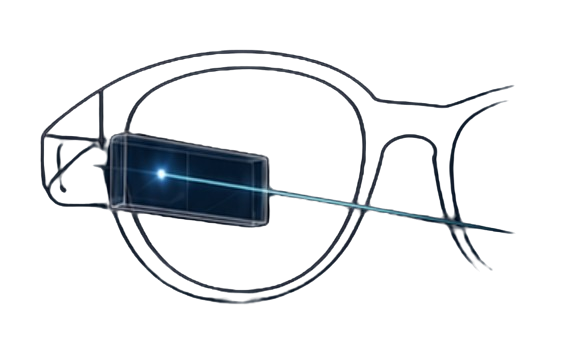
The client is developing lightweight smart glasses. To deliver clear visuals in real-world environments while keeping the overall weight low, a monocular optical see-through display solution was required.
The project focuses on demonstrating the feasibility and performance of the display solution, with objectives including:
- Achieving clear and high-contrast images with full color.
- Ensuring compatibility with a lightweight monocular optical see-through architecture.
- Supporting a Micro-OLED display source.
- Delivering images that remain clear in complex ambient lighting.
- Enabling easy integration into optical and mechanical systems.
- Minimizing overall weight.
- Validating sample performance through matching and system-level verification.
The lightweight monocular optical see-through display solution must balance optical performance, image quality consistency, interface compatibility, form factor, and thermal management. The target specifications are as follows.
| Display Source | 0.23" Micro-OLED |
| Resolution | 640 × 400 |
| Color | Full Color |
| Optical Architecture | Waveguide |
| Field of View | 26° |
| Eyebox (Approx.) | Approx. 55" @ 3 m |
| Pass-Through | > 80% |
| Eye Relief | 0–700 nits (Adjustable) |
| Exit Pupil | 10 × 8 mm |
| Eye Box | < 40 mm |
| Uniformity | < 2% |
| Contrast | ≥ 80% |
| Overall Weight | < 13 g |
| Host & Interface | To be confirmed per project |
Note: Specifications are determined based on display source and optical matching.
The DP-002 (0.23" Micro-OLED display source) and OP-001 (Waveguide) combo provides a balanced setup with 640 × 400 resolution, full color output, and a lightweight architecture.
- Compact size for flexible integration.
- Delivers clear images with high transparency.
- Matchable with various host systems and computing platforms.
- The solution is stable and reliable in imaging performance, light efficiency, and optical integration.
These steps are iteratively validated and optimized to deliver a stable and reliable optical see-through display solution.
After validation, the compatibility of the Micro-OLED, Waveguide, and host/interface was confirmed.
This forms the basis for the final sample validation and future iteration.
- Display image quality meets natural viewing requirements.
- Stable performance across complex lighting conditions.
- Interfaces compatible with host systems and computing platforms.
- Efficient light efficiency and clear imaging.
- Overall weight meets lightweight design targets.
This project will not disclose any client information.
All results are based on sample verification and do not represent mass production capability.