
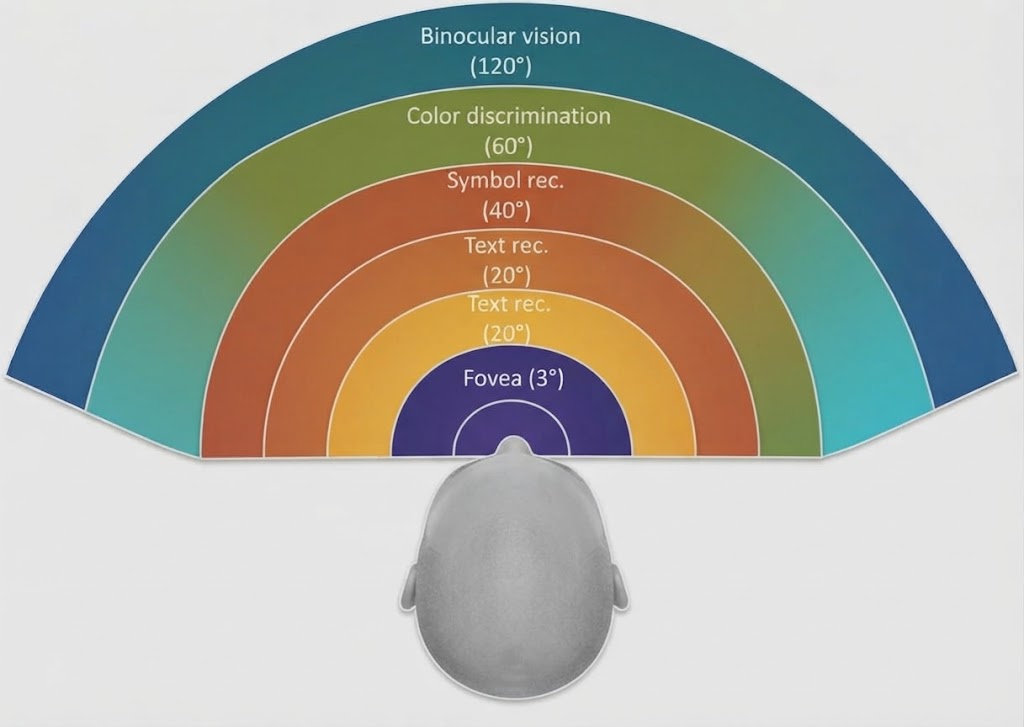
A Near-Eye Display (NED) is a display system positioned several millimetres to a few centimetres from the human eye.
It pairs micro-display chips — including silicon-based Micro-OLED, Micro-LED and LCoS — with optical modules to magnify minuscule images and project them onto the retina. This delivers the visual sensation of viewing a large-format screen situated several metres away.
Why NEDs Do Not Harm Eyes Despite Proximity to the Ocular Surface
Virtual-Image Projection: Human eyes cannot physically focus on objects merely a few millimetres away, which would otherwise produce heavily blurred vision. Optical modules resolve this limitation by reconstructing light emitted from the display source into collimated parallel rays. This relaxes the eye’s crystalline lens and focuses the image onto a virtual focal point 2-3 metres in front of the user.
Field of View (FOV) and Eye-Box: Optical system design defines two critical performance metrics: how wide the perceived screen appears (field of view), and whether imagery remains sharp as the eyeball undergoes moderate rotational movement.
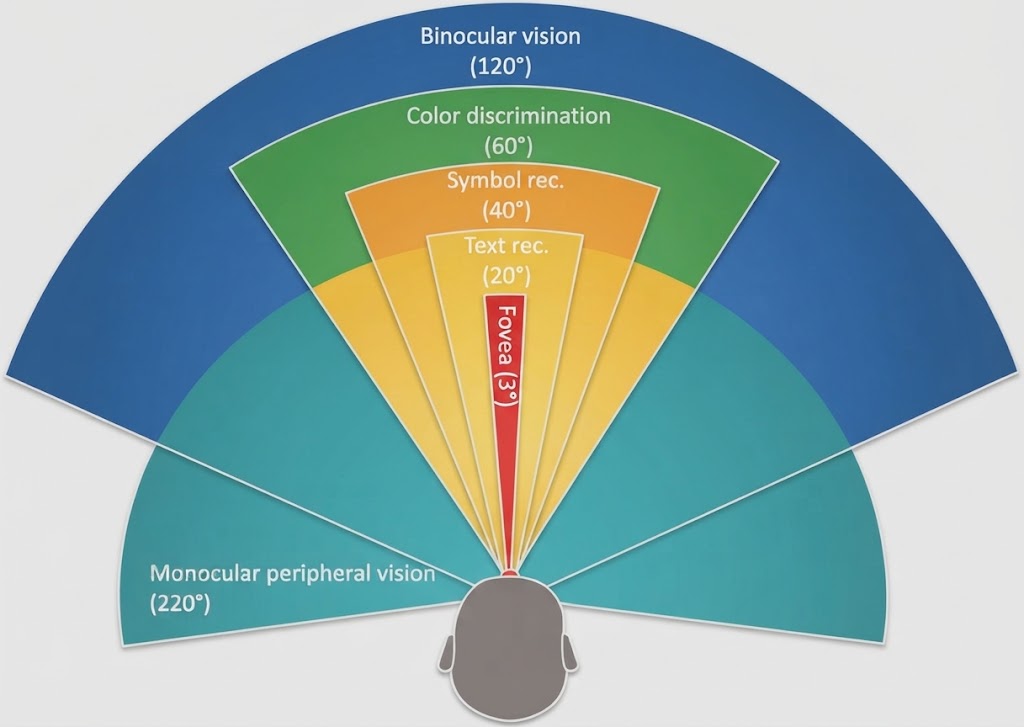
Core NED System Architecture
An NED operates via the coordinated function of three primary subsystems: Micro-Display Engine: Generates miniature imagery with ultra-high pixel density (PPI > 3000). Dominant underlying technologies are silicon-based Micro-OLED (superior contrast ratio), Micro-LED (ultra-high brightness), and LCoS (Liquid-Crystal-on-Silicon).
Imaging Optics & Optical Combiner
- Imaging Optics: Magnifies projected imagery while correcting optical aberration and geometric distortion.
- Optical Combiner (AR-only component): Overlays virtual light output from the micro-display with natural ambient light passing through the real-world environment, enabling virtual-and-real scene fusion.
Driver & Sensor System: Consists of high-density driver PCBs (featuring MIPI / Type-C signal conversion), IMU inertial measurement units, eye-tracking hardware, and SLAM spatial-localisation modules.
Dominant Optical-Display Architecture Matrix
| Application Form Factor | Core Micro-Display Technology | Key Optical Characteristics | Representative Products & Use-Cases |
|---|---|---|---|
| VR / MR Headsets | Fast-LCD / Micro-OLED | Pancake folded optics: drastically reduced lens thickness, deep immersive experience | Apple Vision Pro, Meta Quest 3 |
| Media-viewing & Gaming AR | Silicon-based Micro-OLED | Birdbath optics: accurate colour reproduction, large FOV, moderate cost, thicker lens assembly | XREAL Air 2, Rokid Max |
| Lightweight All-Day Wearable AR | Micro-LED / Micro-OLED | Waveguide (diffractive / array waveguide): lens form-factor comparable to ordinary prescription eyewear | RayNeo X2, Even Realities G1 |
Primary Application Scenarios for Near-Eye Displays
AR Smart Glasses
AR smart glasses and VR/MR headsets — such as Apple Vision Pro, Meta Quest series, and lightweight AR hardware from XREAL and Rokid — power immersive gaming, virtual office workflows, real-time AI teleprompter functionality and cross-language live translation.
Apple (USA) Apple Vision Pro: Dual Micro-OLED panels with greater-than-4K aggregate resolution; built for spatial computing, high-fidelity colour video passthrough, plus gesture and eye-gaze interaction.
Meta (USA) Meta Quest 3 / Quest 3S: Pancake optics with colour passthrough; the highest-volume consumer-grade MR headset globally. Ray-Ban Meta: Display-free AI smart glasses integrating cameras, OpenAI Llama large-model interaction and audio playback.
XREAL (China) XREAL Air 2 / Air 2 Pro / Air 2 Ultra: Silicon-based Micro-OLED paired with Birdbath optics; engineered for pocket-sized virtual large-screen output and 6DOF spatial tracking.
Viture (Global / US-origin) Viture Pro XR / Viture One: Micro-OLED platform with electrochromic lenses, optimised for Steam Deck and Nintendo Switch gaming ecosystems.
Even Realities (Germany) Even Realities G1: Green-emission Micro-LED with diffractive waveguide; ultra-compact 39 g form-factor targeted at AI-driven real-time teleprompter, navigation and translation.
HTC VIVE (Taiwan, China) VIVE XR Elite / VIVE Focus 3: Modular VR/MR headsets for enthusiast-grade and enterprise deployments.
Sony (Japan) PlayStation VR2 (PSVR2): 4K HDR OLED panels equipped with eye-tracking and headset haptic feedback.
FPV Drone Goggles
High-frame-rate, low-latency eyewear for drone pilots delivering instant first-person-view flight feeds.
DJI (China)
DJI Goggles 3: Dual Micro-OLED panels supporting O4 high-definition digital video transmission and Real-View passthrough, paired with the Avata 2 cinewhoop drone. DJI Goggles 2 / FPV Goggles V2: Industry benchmarks within digital FPV video-transmission market.
Fat Shark (USA)
Fat Shark Dominator Digital HD: Digital high-definition FPV goggles built around Micro-OLED displays. Fat Shark HDO2.1: Iconic flagship analogue-video goggle platform compatible with multiple high-frequency receiver modules.
Industrial Inspection & Remote Collaboration
On-site Maintenance and Assembly Guidance: AR head-mounted hardware frees operators’ hands while overlaying digital-twin models, circuit schematics and standard operating procedure (SOP) workflows directly onto physical equipment.
RealWear (USA)
Flagship hardware: Navigator 520 / 500, HMT-1, HMT-1Z1 (intrinsically-safe explosion-proof variant). Key strengths: Voice-first operation with advanced noise suppression; IP66 ingress protection and high drop resistance. The HMT-1Z1 holds Zone 1/21 intrinsic-safety certification.
Microsoft (USA)
Flagship hardware: HoloLens 2 / HoloLens 2 Industrial Edition. Key strengths: Binocular MR headset with high-precision hand tracking and spatial mapping. The industrial variant complies with ISO 14644-1 Class 5-8 clean-room standards and UL Class I, Div 2 hazardous-location certification. Natively integrated with Dynamics 365 Remote Assist and Dynamics 365 Guides for 3D-based SOP instruction.
Remote Expert Support: On-site personnel stream their live field-of-view via NED hardware to off-site specialists. Annotated guidance from remote experts renders in real time within the on-site worker’s field of vision.
PTC (USA)
Core software suite: Vuforia Industrial Platform (Vuforia Chalk, Vuforia Expert Capture, Vuforia Studio). Core capabilities: Vuforia Chalk enables remote specialists to place 3D spatial annotations (directional arrows, component highlighting) atop live on-site video feeds. Expert Capture captures subject-matter-expert workflows and converts recorded operations into AR-ready standard SOP content.
Medical Assistance and Precision Surgery
AR Surgical Navigation: Systems such as the Augmedics spinal-surgery platform allow surgeons wearing AR headsets to visualise patient anatomical structures via augmented reality, precisely aligning registered CT/MRI scan datasets onto surgical sites.
Robotic-Surgery Visual Subsystems: The surgeon-console ocular viewers for da Vinci surgical robots deploy high-definition binocular NED hardware, delivering high-contrast, zero-latency 3D endoscopic imagery for operating physicians.
Military-Spec Equipment & Outdoor Night-Vision
Tactical soldier head-mounted displays and pilot HMDs overlay flight telemetry, terrain elevation maps and tactical situational data directly into the end-user line-of-sight. Thermal-imaging and night-vision scopes (such as premium devices manufactured by Pulsar): convert infrared sensor readings into imagery rendered on micro-display panels for firearms aiming and field reconnaissance missions.
Sports-oriented Automotive & Cycling HUD
Sports HUD eyewear including Garmin cycling HUD units and ENGO sports glasses project real-time biometrics (heart rate, cadence), navigation prompts and pace metrics onto lens peripherals. This eliminates safety risks caused by athletes looking down at wrist-worn wearables.
References
[1] Society for Information Display (SID). Optical Principles of Near-Eye Displays and Collimated Virtual Image Formation.
[2] IEEE Transactions on Electron Devices. Silicon-Based Micro-OLED and Micro-LED Architectures for Near-Eye Display Applications.
[3] SPIE Digital Library. Waveguide and Freeform Optics in Augmented Reality Smart Glasses.
[4] Apple Inc. Apple Vision Pro Spatial Computing Hardware & Micro-OLED Display Architecture.
[5] Meta Reality Labs. Meta Quest 3 Optical System Overview and Pancake Lens Design.
[6] DJI Technology Co., Ltd. DJI Goggles 3 and O4 Digital Video Transmission System Technical Whitepaper.
[7] RealWear, Inc. RealWear Navigator 500 & HMT-1Z1 Intrinsically Safe Hardware Specification.
[8] Microsoft Corporation. HoloLens 2 Industrial Edition & Dynamics 365 Mixed Reality Documentation.
[9] U.S. Food and Drug Administration (FDA). Augmedics xvision-Spine System (XVS) 510(k) Regulatory Clearance Documentation.
[10] Pulsar Optics. Thermion & Merger Micro-OLED Thermal Imaging Systems Specifications.
Disclaimer
This document is compiled based on public technical documentation, industry standards, and commercial case studies for technical exchange and informational purposes only. It does not constitute commercial procurement, investment advice, or operational guidance. All brand names, trademarks, and product specifications belong to their respective owners.