
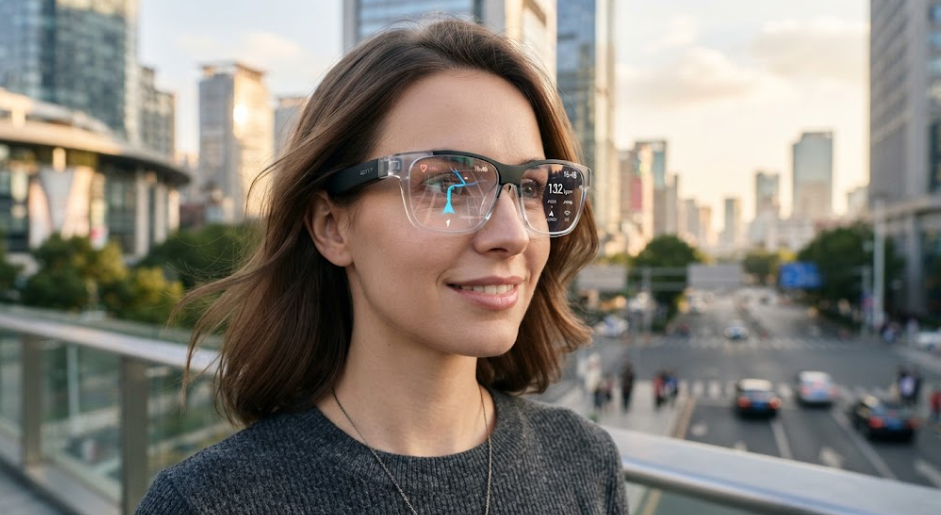
In the near-eye-display era, silicon-based Micro-OLED panels boasting 3000+ PPI are widely regarded as the definitive hardware solution for technology iteration.
Nevertheless, industry data from Yole Intelligence indicates that near-eye-display optical engines suffer average optical losses ranging from 85 % to 99 %. This renders off-the-shelf standard-spec panels ineffective under bright ambient sunlight. Much like Apple’s deep collaborative customisation with TSMC and Sony for the Vision Pro — covering CMOS driver backplanes and micro-structured emissive layers — generic standard panels cannot deliver the peak performance required for near-eye and specialised display applications.
Why Off-the-Shelf Micro-Display Panels Fall Short
Standard panels typically deliver 1 000‑3 000 nits of peak brightness. After refraction via Birdbath or waveguide optics, on-eye brightness drops to merely tens or even single-digit nits, making outdoor sunlight usability impossible.
Furthermore, standard panels feature fixed physical dimensions and wide-bezel driver IC layouts, which introduce severe bezel shadowing and image distortion within micron-scale optical paths.
Industry Pain Points Addressed by Tailored OLED Micro-Displays
Off-the-shelf Panels Cannot Fit Compact Lightweight Optical Engines
Commercially available Micro-OLED panels come with fixed resolution, form-factors (e.g. 0.39‑inch, 0.55‑inch), driver interfaces and oversized edge seal areas. Direct integration of standard panels into AR/VR near-eye hardware frequently yields oversized optical engines due to poor dimensional matching between the panel and exit-pupil optics.
Case Study: Brilliant Labs (Frame AI Glasses)
The brand set out to build a minimalist eyewear form-factor weighing only 39 grams as a core competitive differentiator. Standard-size Micro-OLED driver assemblies could not satisfy this design goal. Only Tailored silicon-based OLED micro-display modules with ultra-compact dimensions and bespoke aspect ratios enable micron-scale integration of displays, driver ICs and miniature optics, allowing full assembly to fit centrally within the eyeglass frame.
Insufficient Brightness and Poor Temperature Tolerance for Outdoor Environments
Standard Micro-OLED panels deliver roughly 1 000‑3 000 nits output. After optical-system attenuation, on-eye brightness becomes inadequate for readable imagery in outdoor targeting systems, automotive AR-HUD units and aviation head-mounted displays. Standard panels also suffer colour shift and luminance degradation under extreme high-low temperature conditions, mandating purpose-built Tailored OLED micro-display assemblies.
Case Study: Pulsar (Thermion / Merger Premium Thermal-Imaging Sight Series)
These rugged outdoor targeting devices must operate continuously across extreme ambient conditions spanning −25 °C to +50 °C, thresholds unfit for conventional Micro-OLED hardware. Pulsar deployed custom silicon-based Micro-OLED panels upgraded with high-vibration-resistant packaging, microlens-array brightness-enhancement technology and wide-temperature CMOS driver backplanes, enabling reliable performance in harsh field environments.
Excessive Heat Generation and Short Battery Endurance
For consumer-grade near-eye wearables such as sports-focused AR glasses, battery capacity rarely supports all-day continuous use. Users suffer range anxiety from frequent recharging cycles. Standard-panel driver circuitry and display profiles lack power-use optimisation; they draw excessive current even when high brightness is unnecessary, causing substantial chip heating that risks skin irritation while rapidly depleting battery charge.
Case Study: ActiveLook / ENGO (ENGO 2 Lightweight Sports AR Glasses)
Built for multi-hour marathon wear to track runner heart rate and pace metrics, these glasses demand extended runtime. The brand partnered with specialised micro-display solution providers for custom ultra-low-power Micro-OLED driver ICs and display backplanes. Pixel refresh logic was tuned for monochrome and high-contrast data streams, cutting optical-engine power draw and delivering over 12 hours of continuous runtime.
High Minimum-Order Quantities and Risk of End-of-Life Discontinuation for Mainstream Standard Panels
Consumer-oriented Micro-OLED suppliers such as Sony and BOE often enforce large-volume MOQs in the tens-of-thousands of units, alongside short product lifecycles with end-of-life (EOL) obsolescence within 2‑3 years. Medical and industrial equipment typically require only thousands of units annually. Medical hardware additionally undergoes multi-year FDA/CE certification cycles, after which hardware part-number changes are prohibited — creating significant risk of supply-chain disruption.
Case Study: Augmedics (Xvision Spine System AR Surgical Navigation Helmet)
As an FDA-cleared medical AR device, Augmedics adopted a custom medical-grade Micro-Display solution. This locked in fixed panel physical specifications and driver-chip configurations, backed by a 5‑10‑year EOL-mitigated long-term supply agreement from the vendor. Each unit also receives factory-calibrated binocular gamma and colour-temperature tuning.
Image Distortion and Motion-Induced Vertigo in Demanding Use-Cases
Professional photographers are familiar with this limitation: in digital-camera electronic viewfinders (EVFs), off-the-shelf panels exhibit visible colour banding and amplified noise under low-light, low-greyscale conditions, degrading preview fidelity for final image capture. During high-speed tracking such as sports photography for football or horse-racing events, noticeable motion smear further impairs usability.
Case Study: Canon Flagship Mirrorless-Camera EVFs
Canon requires EVF performance matching the real-time responsiveness and colour fidelity of optical viewfinders. Camera OEMs deploy custom high-refresh-rate (120 Hz+) high-PPI silicon-based Micro-OLED panels. Optimisations cover CMOS-driver backplane low-greyscale gamma curves and microsecond-scale pixel response times, eliminating motion smear and shadow-area colour artefacts during rapid camera panning.
References
[1] Yole Intelligence. (2026). Silicon-Based Micro-OLED for AR, VR & Specialised Displays Market Report. Yole Group.
[2] SPIE. (2025). Optical Loss Budget for Near-Eye Display Optical-Engine Architectures, SPIE Photonics West Proceedings.
[3] Display Supply Chain Consultants. (2026). EOL Risk & Long-Term Component Sourcing for Medical-Grade Micro-Displays.
[4] LEDinside. (2026). Micro-OLED Power-Optimisation and Thermal-Design for Wearable AR Systems.
[5] SID. (2025). Low-Greyscale Gamma Tuning for High-Performance EVF Micro-Displays.
[6] FDA. (2024). Guidance for Medical Device Component Change Control Post-Certification.
[7] TrendForce. (2026). Custom vs Off-the-Shelf Micro-Display Module Benchmark Analysis.
[8] Counterpoint Research. (2026). AR Sports Glasses Hardware & Power-Consumption Benchmark Report.
[9] OSAT Forum Whitepaper. (2025). Ruggedised Wide-Temperature Packaging for Micro-Displays.
[10] IPC-9701-2. (2024). Performance Standard for Vibration-Resistant Optoelectronic Packaging.
Legal Disclaimer
This document serves purely as general technical reference material and does not constitute engineering consultancy, procurement guidance or regulatory-compliance advice. All trademarks and product names belong to their respective rights-holders. Market-related insights draw upon publicly available third-party industry research. Actual product performance, supply timelines and commercial outcomes may materially vary due to manufacturing yield, component availability and regulatory revisions. Before project execution, readers must independently validate all technical parameters, MOQ constraints, environmental qualification requirements and long-term component-supply risks. No warranty, express or implied, is offered regarding completeness or factual accuracy of statements within this paper.