
Overview
Fraunhofer Institute for Photonic Microsystems (Fraunhofer IPMS) has developed an innovative red Micro OLED microdisplay built around a novel high-efficiency OLED stack architecture, resolving the long-standing brightness bottleneck for red emission.
Achieving exceptional brightness alongside ultra-low power consumption has remained a persistent tradeoff in wearables and augmented reality (AR). Researchers continue pushing to overcome these technical barriers, with a key priority of stabilizing mass production while driving down manufacturing costs.
Fraunhofer IPMS recently announced its newly developed red Micro OLED microdisplay, delivering both ultra-high brightness and superior power efficiency. The pioneering technology was first unveiled at the SID Europe Mid-Term Symposium in Lisbon, Portugal, sparking widespread industry discussion. Though the initial public reveal took place back in February 2026, the innovation still merits in-depth technical analysis.
Core Technical Breakthrough of the New Red Micro OLED Microdisplay
For years within the microdisplay sector, performance gains for green and blue Micro OLED devices have progressed steadily. Red OLED materials, however, carry inherent limitations: they tend to overheat under high brightness operation, accompanied by excessive power draw and accelerated luminance degradation.
The continued investment in red OLED material development remains essential because red emission forms the foundation of full-color RGB displays. Efficient, stable red subpixels are indispensable for high-fidelity full-color Micro OLED panels. Compared with the compromise approach of white OLED paired with color filters, direct-emission RGB architectures deliver superior luminous efficiency and purer color reproduction. Red wavelengths are also critical for rendering high-contrast graphical symbols in AR glasses, automotive head-up displays (HUDs), and professional optical instruments[1].
Fraunhofer IPMS researchers solved this challenge by engineering a new OLED stack incorporating high-performance materials. The design delivers a substantial leap in red light emission efficiency and offers strong process compatibility, enabling straightforward transfer and integration onto silicon backplanes of varied specifications[1].
This breakthrough unlocks a major practical advantage: microdisplays powered by this stack retain sharp, high-contrast imagery even under direct bright outdoor sunlight. Institute researchers state the team will build upon this new stack architecture to develop custom high-brightness Micro OLED products tailored for targeted use cases.
35,000 cd/m² Peak Brightness: How Does Its Intelligent Power-Saving Mechanism Work?
Fraunhofer IPMS published compelling performance metrics during its presentation. According to Uwe Vogel, Head of the Microdisplays and Sensors Division at the institute, the new red Micro OLED microdisplay reaches a peak brightness of 35,000 cd/m² while maintaining low power consumption[1].
At the heart of this efficiency lies its differentiated pixel refresh technology, a low-level ultra-low-power innovation. Instead of refreshing the entire frame with every image update, the system only modifies pixels where content has changed.
Nevertheless, potential drawbacks have been raised by industry observers. If the algorithm fails to detect pixel state changes accurately, or if minor discrepancies exist in OLED pixel response speeds, motion artifacts or brightness flicker may appear along the edges of fast-moving on-screen objects. As self-emissive components, OLED pixels also degrade faster at higher brightness and longer operating durations, creating risk of uneven pixel ageing over extended use.
Streamlined Optical Assembly and Expanded Application Scope
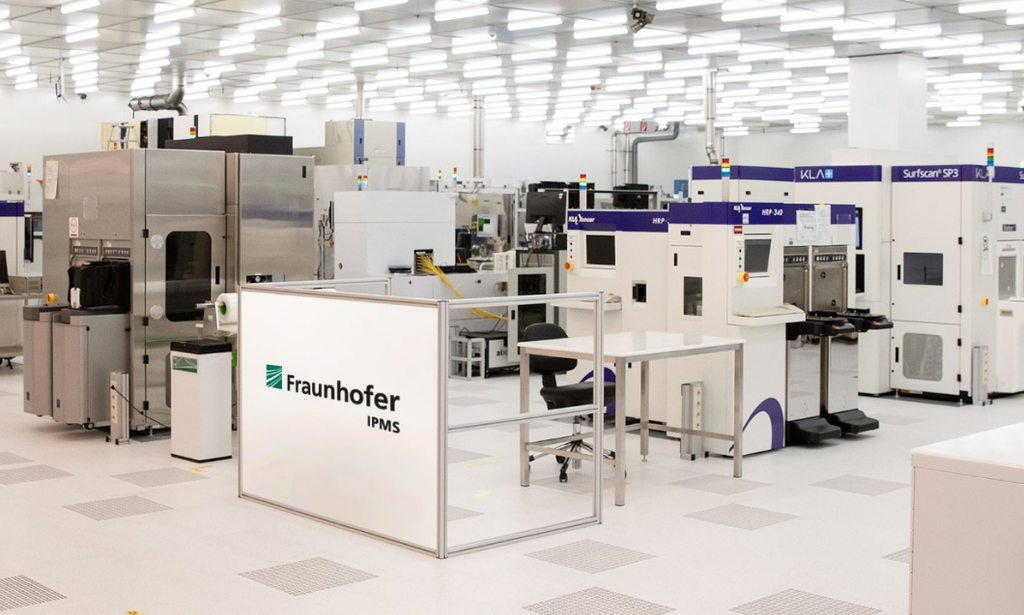
Thanks to its compact architecture, Fraunhofer IPMS’ latest innovation greatly elevates overall microdisplay system performance. Manufactured on standard CMOS semiconductor processes and supported by high-performance silicon backplanes, the new display leverages the institute’s established expertise and can rapidly transition toward mass production[1].
Beyond rendering crisp full graphical symbols, the device improves precision pixel alignment accuracy and drastically simplifies downstream optical assembly workflows.
Evolution of Fraunhofer IPMS’ Technology Roadmap
Fraunhofer IPMS has delivered a string of cutting-edge photonic innovations over recent years. In 2016, the institute successfully demonstrated a high-efficiency full-color RGBW OLED microdisplay fabricated on a 28 nm CMOS process. By integrating computing functions directly within the backplane, the design converts standard RGB signals into white subpixels on-chip. It achieves a pixel size of 2.52 × 2.52 µm² and an ultra-high pixel density of 5040 PPI[2]. This milestone marks the shift of microdisplays toward intelligent microsystems, where panels handle not only image output but also on-chip algorithm processing and power optimization.
The institute has also developed high-resolution 2K OLED microdisplays built for near-eye display applications[1].
Beyond microdisplays, Fraunhofer IPMS holds global leadership in spatial light modulators and a 300 mm CMOS-compatible quantum device development platform. These efforts position the institute to build foundational photonic infrastructure for future optoelectronic integration. Spatial light modulators serve as core hardware for holographic displays, laser material processing and premium optical instruments, while 300 mm CMOS-compatible quantum devices pave the way for next-generation quantum computing and advanced photonic chip fabrication[3].
Industry Outlook
Micro OLED technology will continue advancing toward higher resolution, reduced power draw and greater luminance. Fraunhofer IPMS’ dual breakthrough in red emission efficiency and power management sets a powerful benchmark for the entire industry.
References
[1] Fraunhofer IPMS. (2026). New high-brightness red Micro OLED microdisplay for AR and HUD applications.
[2] Fraunhofer IPMS. (2016). 5040 PPI RGBW OLED microdisplay on 28nm CMOS.
[3] Fraunhofer IPMS. (2025). Spatial light modulators and 300mm CMOS quantum photonics platform.
[4] SID (Society for Information Display). (2026). SID Europe Mid-Term Symposium, Lisbon conference proceedings.
[5] Omdia. (2026). Near-eye microdisplay technology report 2026–2030.
[6] TrendForce. (2026). Micro OLED and silicon-based OLEDoS supply chain analysis.
[7] UBI Research. (2026). Red subpixel performance limitations in RGB Micro OLED panels.
[8] AR/VR Association. (2026). Automotive HUD and AR glasses display benchmark study.
[9] IEEE Electron Devices Society. (2026). OLED stack architecture & luminance lifetime modelling.
[10] Display Daily. (2026). Fraunhofer IPMS presents red Micro OLED breakthrough at SID Europe.
Legal Disclaimer
This article is for informational purposes only and shall not be construed as investment or technical procurement advice. All performance parameters, manufacturing timelines and application forecasts are subject to modification due to material iteration, process tuning and commercial planning. The author and translator accept no liability for commercial, engineering or investment decisions made based on this content. All trademarks mentioned belong to their respective holders.