
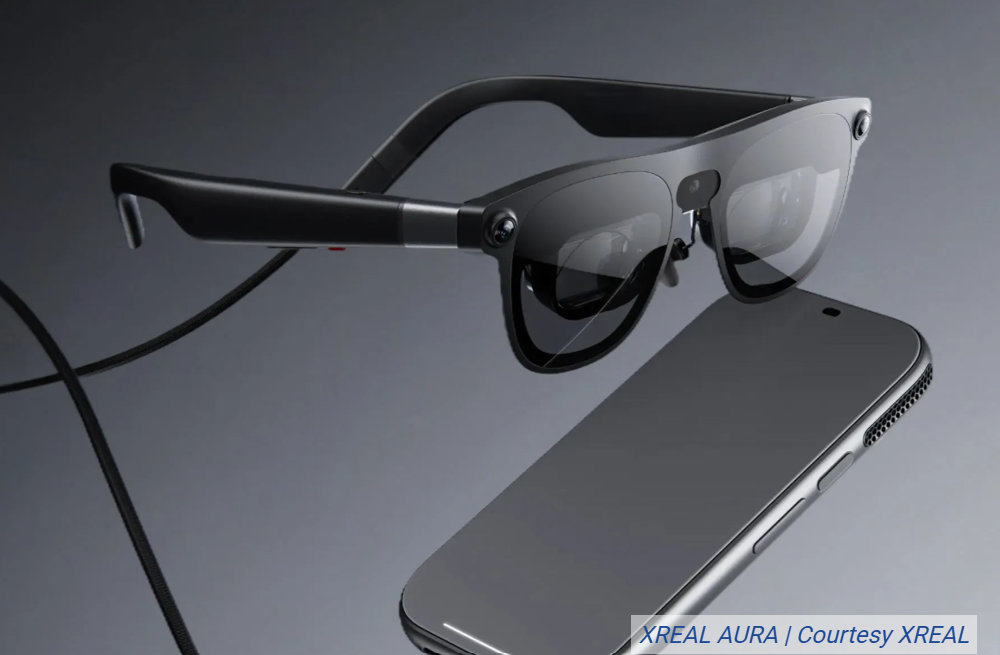
As the first AR glasses powered by the Android XR operating system, the XREAL Aura drew widespread industry attention upon its unveiling at AWE 2026.
According to the latest updates, the XREAL Aura is available for pre-order via XREAL’s official website and is scheduled to launch commercially this autumn. The final retail price remains undisclosed; the manufacturer has only stated it will sit “below $1,500 USD”, leaving substantial room for market speculation. Industry analysts, drawing on comparable product benchmarks, estimate a realistic price bracket between $1,000 and $1,500 USD.
One design choice that has resonated strongly with technical observers is that the XREAL Aura forgoes array and diffractive waveguide architectures commonly seen in modern smart glasses. Instead, it builds upon and refines the established Birdbath optical framework.
Trade-offs Between Device Form-Factor and Image Fidelity
The XREAL Aura houses two Sony Micro-OLED (silicon-based OLED) micro-display panels, delivering 1920 × 1200 per-eye resolution in a 16:10 aspect ratio, with dynamic refresh rates up to 120 Hz. Leveraging the per-pixel dimming capability native to Micro-OLED technology, the unit produces vivid colour saturation and high-contrast imagery.
Industry commentators note that while waveguides enable ultra-thin lens profiles, they suffer well-documented drawbacks: optical efficiency often falls below 1 %, accompanied by severe chromatic dispersion and degraded contrast. The Birdbath configuration, by contrast, results in a somewhat bulkier headset yet delivers excellent light utilisation and superior optical image quality, fully unlocking the colour and peak-brightness strengths of Sony’s Micro-OLED panels.
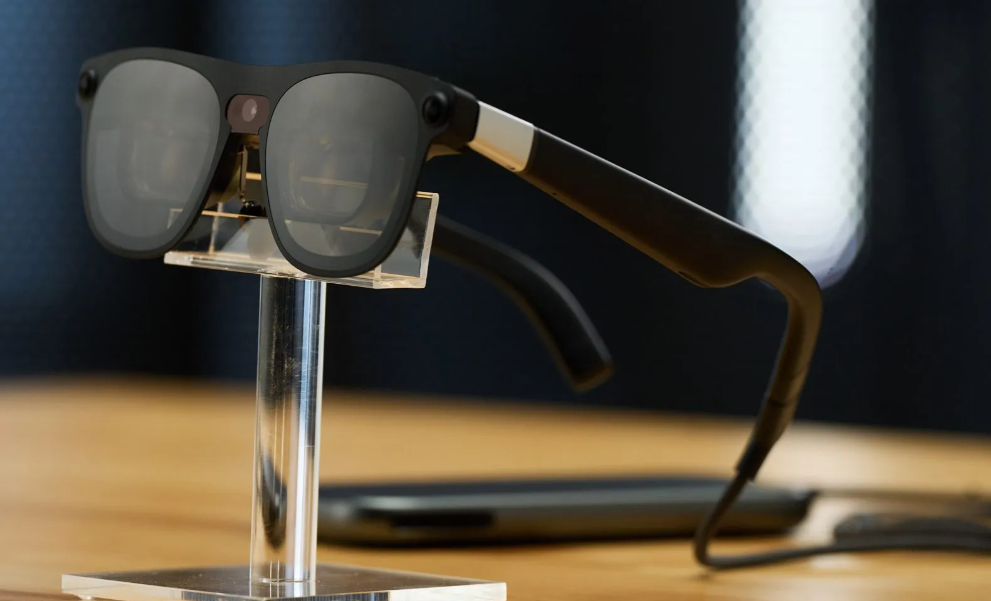
That said, the Birdbath design increases eye-to-lens separation. Stacked curved reflectors and polarising beam splitters add considerable thickness to the front assembly — the primary reason the Aura appears substantial when viewed from the side.
Dual-Mode Fusion: Optical See-Through (OST) and Electrochromic Dimming
Fundamentally, the Aura is a true Optical See-Through (OST) AR device. Real-world light passes directly through the optics rather than being captured by cameras and re-rendered on-display. This eliminates resolution degradation and motion smear, while minimising simulator sickness.
To enable seamless switching between AR and VR modes, the Aura integrates sophisticated electrochromic dimming technology. The outer lens supports five manually adjustable opacity levels spanning full transparency to near-complete opacity, or automatic control driven by the Android XR system based on active applications. Lenses stay fully transparent during AR workflows and darken for immersive VR content, delivering dual-mode functionality within a single headset.
This capability does come with inherent compromises. Owing to the physical properties of Birdbath beam-splitter optics, maximum natural-light transmittance cannot reach 100 % even at its most transparent setting. Users perceive an effect comparable to wearing lightly tinted sunglasses rather than achieving perfect clarity. Real-world testing confirms safe outdoor navigation under bright ambient light, though the subtle darkening effect can feel slightly unnatural.
Field trials also reveal a fundamental tension between open-view usability and immersion. In AR mode, the unobstructed peripheral view preserves strong situational awareness of the physical environment. In fully darkened VR mode however, peripheral vision still picks up real-world surroundings, creating a contrast against the central virtual scene and moderately reducing immersive depth.
Real-World Performance: 70° Diagonal Field-of-View and PPD Metrics
Most commercially available waveguide AR glasses today deliver a field-of-view confined to the 30°–50° range. The XREAL Aura stands out by pushing diagonal FOV to 70°, widely regarded as a meaningful performance threshold for XR displays. Paired with its 1920 × 1200 per-eye resolution, the headset maintains competitive angular resolution (PPD), yielding sharp, crisp visuals.
In hands-on evaluation, text rendered for spatial Google Docs exhibits exceptionally clean character edges, supporting comfortable document editing and web browsing. Colour-fidelity performance remains strong for both 2D YouTube playback and 3D content consumption.
Personal hands-on observations:
- Google Chrome: YouTube video playback proved satisfying.
- WebXR within Chrome: Overall WebXR performance met expectations.
- Google Maps: Pulling up a location in Paris placed a virtual representation of the Eiffel Tower directly in my field of view, creating a convincing sense of presence.
- Google Docs: Document editing felt responsive and fluid, viable for serious productivity-oriented work.
Given its native 16:10 panel aspect ratio, the expanded 70° FOV benefits primarily horizontal coverage, while vertical field-of-view remains comparatively constrained. Users notice limited overhead visibility when consuming 360-degree panoramic immersive video. Minor image distortion can appear along render boundaries during rapid head movements, an area set to benefit from future software refinements and distortion-correction algorithm updates.
Final Impressions
Overall, the XREAL Aura makes for a compelling piece of hardware. Despite its noticeable front-end thickness, it remains lightweight on the head. It delivers a practical field-of-view, intuitive interaction, and native support for both AR and VR experiences — all wrapped in a visually distinctive wearable form-factor.
Even in 2026, AR technology is still in its early-generation phase, so the headset carries genuine limitations as outlined above. From side profiles, its silhouette can look somewhat awkward on wearers with prescription eyewear.
Even so, I consider the XREAL Aura a solid step forward for consumer-grade augmented reality. If you are seeking indoor-focused AR glasses backed by a mature operating system and robust compute performance, it merits serious consideration.
References
[1] AWE (2026). XREAL Aura Official Product Briefing.
[2] Android XR Technical Documentation (2026). Operating-system specification for third-party AR headsets.
[3] Yole Intelligence (2026). Birdbath versus Diffractive Waveguide: Optical-Efficiency Benchmark Report.
[4] Display Daily (2026). Micro-OLED for consumer-focused lightweight AR glasses.
Legal Disclaimer
This text reflects independent hands-on-style technical assessment for reference purposes only. It is not official product specification, purchasing guidance or investment advice. All trademarks belong to their respective holders. Estimated pricing and performance observations are derived from pre-release hardware evaluations. Real-world experience varies with ambient lighting, facial fit and individual eyesight. Always cross-validate parameters against manufacturer-released datasheets prior to commercial deployment. No warranty, explicit or implied, is given regarding completeness or factual accuracy.