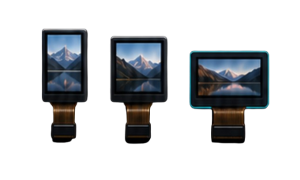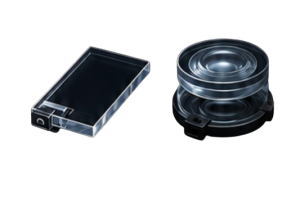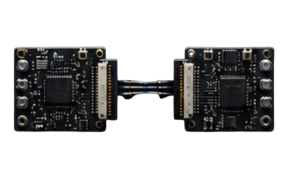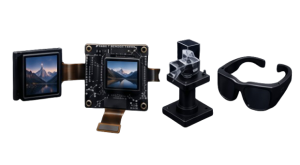

When it comes to microdisplay technology for extended reality (XR), the industry has yet to settle on a definitive winner between Micro OLED and Micro LED. While Micro OLED is widely tipped as the mainstream long-term solution, sustained improvements in manufacturing yield are far from guaranteed.
Against this backdrop, Goertek, a leading industry player, has avoided overcommitting to a single technical path. Instead, it has adopted a dual-track strategy to push forward Micro OLED and Micro LED programs concurrently.
I. Micro OLED vs. Micro LED: Why Not Pick Just One?
There is no need to choose only one route, because Micro OLED (OLEDoS) and Micro LED each occupy irreplaceable positions in XR hardware, tailored to distinct use cases and optical architectures.
Micro OLED
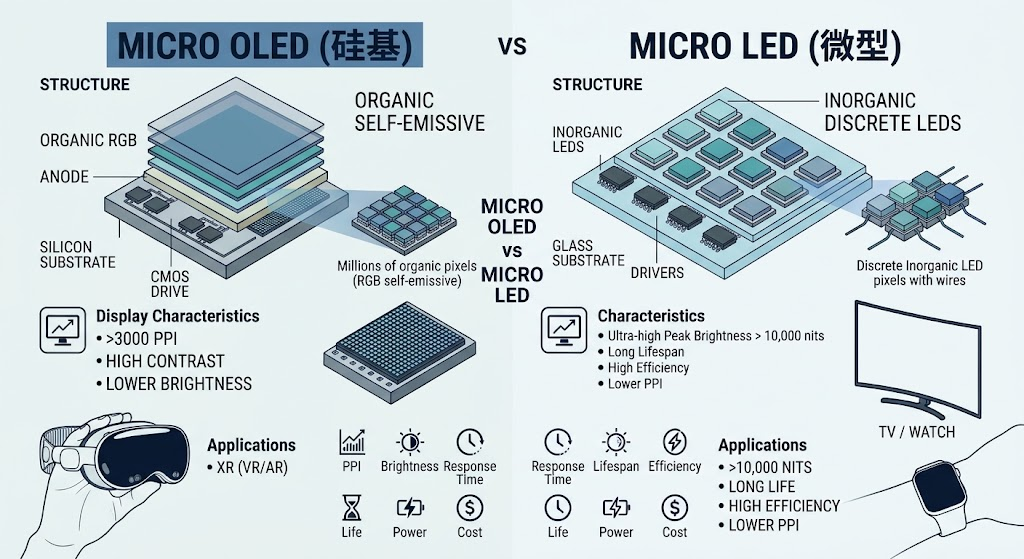
Micro OLED delivers ultra-high resolution and pristine image quality that cannot be matched by Micro LED. It supports pixel densities in the thousands of PPI, making it the dominant choice for high-immersion VR/MR headsets and AR viewing glasses built around the BirdBath optical design. Expanding investment in Micro OLED not only builds technological moats but also secures more mid-to-high-end downstream customers. Goertek unveiled its in-house 4K Micro OLED module commercially in 2025.
Devices powered by this technology include:
Apple Vision Pro (equipped with Sony’s silicon-based OLED microdisplay);
Huawei Vision Glass and XREAL Air series AR viewing eyewear;
Sony PlayStation VR2 (PS VR2);
Bigscreen Beyond;
Panasonic MeganeX;
RayNeo AR viewing glasses.
Micro LED
Micro LED excels in peak brightness and ultra-miniaturization. Single-green Micro LED light engines have already entered mass production for lightweight all-in-one AR devices. Industry trends show that Micro OLED paired with BirdBath optics offers a cost-effective short-term solution for entry-level media-focused AR glasses, whereas single-green or full-color Micro LED paired with diffractive or silicon carbide (SiC) waveguides represents the next frontier.
These two technologies are not purely substitutive; they align with diverging form factors for XR hardware. Micro OLED targets the existing market of immersive media consumption and MR mixed reality, while Micro LED captures future growth in lightweight AR eyewear designed for all-day, everyday wear.
II. Goertek’s Core Micro OLED Roadmap and Key Milestones
- Micro OLED Mass Production at Jinan Plant (2025–2026) Goertek has installed high-precision OLED evaporation systems from South Korea’s Sunic System at its Jinan manufacturing base. Back in January 2025, Sunic System signed a KRW 41 billion (approximately RMB 197 million) equipment supply contract with Jinan Goertek Pixel, a Goertek subsidiary. The firm sources CMOS backplanes primarily from industrial partners such as JHICC (Jinghe Integrated Circuits).
- Micro LED Line Assessment in Zhangjiang, Shanghai (H2 2026) Industry sources confirm Goertek is evaluating a new Micro LED production line in Zhangjiang, Shanghai, with a monthly capacity of 6,000 12-inch wafers, prioritizing Micro LED rollout. Goertek publicly stated in March 2026 that it had no immediate plans for Micro LED manufacturing, yet its stance is now shifting. This move reflects the company’s forward-looking confidence ahead of the projected AR volume ramp-up in 2027–2028.
III. From Contract Manufacturer to Vertical Component Maker
Goertek has long stood as a top global OEM for XR finished devices and optical modules. Despite its massive shipment volume, the company previously relied heavily on external suppliers for microdisplay panels, limiting its pricing power and value capture in end products.
With the Jinan Micro OLED fab under construction and the Shanghai Micro LED project under review, Goertek is building full vertical integration spanning microdisplay panels, optical modules, and finished device assembly. As stated in investor briefings, vertical control over core components is the only viable path to meaningful profit margin improvement. Building in-house panel capacity will drastically reduce reliance on leading external display suppliers.
IV. Two Key Market Variables
While Sunic System’s evaporation tools hold solid market penetration for OLEDoS production, silicon-based OLED still faces a fundamental bottleneck: process compatibility between the CMOS backplane and the emissive layer. The speed of yield improvement for mass-scale production will directly determine whether Goertek can build a lasting cost advantage within the Micro OLED window of opportunity.
Meanwhile, Micro OLED faces sustained long-term competitive pressure from Micro LED, which is rapidly gaining traction in lightweight all-day AR built around waveguide optics. This technological split forces Micro OLED developers to keep boosting brightness and cutting power consumption to defend their position in immersive near-eye displays, as Micro LED reaches production maturity earlier for consumer-grade AR eyewear.
Running two parallel programs gives Goertek substantial strategic flexibility amid an uncertain XR technology landscape. The tradeoff, however, is doubled capital expenditure (CapEx) and stringent yield targets across two separate product lines.
Disclaimer
This content is for industry information and reference only and does not constitute investment advice or commercial decision-making guidance. All investments carry risks.
References
- UBI Research. (2025). Sunic System Secures KRW 41 Billion Micro OLED Evaporation Tool Order with Goertek.
- JHICC Official Release. (2025–2026). JHICC’s 40nm OLED Driver Chip Tape-out and OLEDoS Industrial Chain Progress.
- Goertek Inc. (2025). Goertek Launches New-Generation 4K Micro OLED Eyewear Optical Modules and XR Microdisplay Solutions.
- TrendForce. (2026). 2026 Global AR/VR Near-Eye Display Outlook: Micro OLED vs Micro LED Technology Divergence Whitepaper.
- Omdia. (2026). XR Microdisplay Landscape: Supply Chain Restructuring from OEM to Vertical Panel Integration, Omdia Display Device Market Tracker.
- Securities Times . (2026). Goertek Investor Relations Minutes: Vertical Integration of Core Components and CapEx Strategy.
- Display Supply Chain Consultants (DSCC). (2026). Micro OLED & Micro LED Mass Production Yield Ramp and Capital Expenditure Challenges.
- Sina Finance & Jiemian News. (2026). AR Glasses Volume Growth Outlook: Micro LED Industrial Investment Timing and Vendor Tracking.