Shenzhen Pengsheng MicroVision Tech Co., Ltd.




According to industry reports from market research authorities Omdia and DSCC, the global micro-display market is projected to exceed $4 billion within the next few years, maintaining a compound annual growth rate (CAGR) of over 30%, fueled by the surge in Apple Vision Pro adoption and AI/AR smart glasses [1, 2].
Industry Perspective:
“Shrinking AR/VR hardware from bulky head-mounted displays into everyday eyewear hinges on the extreme convergence of micro-displays and optics. A micro-display module is far more than a simple display panel; it represents a deeply integrated system combining silicon-based semiconductor backplanes, micro/nano light-emitting arrays, and precision micro-optics within a sub-centimeter footprint.”
— Dr. Bernard Kress (Former SPIE President, former Director of AR Hardware Engineering at Google, and former Principal Optical Architect for Microsoft HoloLens) [3]
What Is a Micro-Display Module?
In simple terms, a micro-display module is an integrated, turn-key visual engine. It packages a tiny high-resolution display panel—often measuring just 1 cm²—alongside a dedicated display driver and specialized optical lenses into a single self-contained unit.
To understand the distinction: a raw light-emitting chip or wafer (such as a Micro-OLED wafer) is merely one raw component. A micro-display module unifies the Micro-OLED panel, driver integrated circuits (ICs), flexible printed circuits (FPCs), and optical assemblies into a complete optical subsystem.
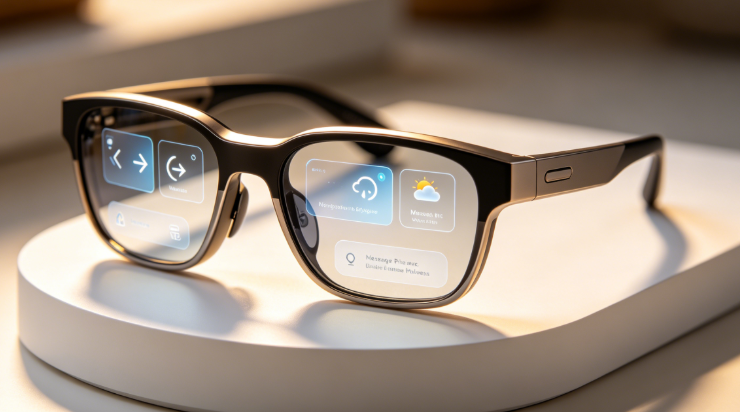
For smart glasses manufacturers (such as Apple, Meta, and XREAL), incorporating a micro-display module is plug-and-play. Once mounted into the chassis and connected to power and data ribbons, the module immediately projects a massive, crisp virtual screen directly before the user’s eyes.
What’s Inside a Micro-Display Module?
Despite weighing only a few grams and measuring mere centimeters across, a micro-display module houses four ultra-precise core components:
 [ Driver Control Board ] ──> (Processes and translates video signals)
            │
 [ Micro-Display Panel  ] ──> (Fingernail-sized light source, ultra-high PPI)
            │
 [ Optical Lens System  ] ──> (Refracts and magnifies images for the eye)
            │
 [ Precision Housing    ] ──> (Micron-level alignment, dust sealing & thermal dissipation)
1. Micro-Display Panel (The Light Engine)
Built on Micro-OLED (Silicon-based OLED / OLEDoS) or Micro-LED technology, these displays typically feature diagonal sizes under 1.3 inches —and often as small as 0.5 inches . Despite their compact size, they achieve pixel densities between 3,000 and 7,000+ PPI (pixels per inch). For context, standard smartphone displays hover around 400 PPI ; a micro-display panel delivers over 10 times the visual detail, virtually eliminating screen-door effects [4].
2. Driver ICs and Circuitry (The Neural Link)
Consisting of driver ICs mounted on Flexible Printed Circuits (FPC), this subsystem receives video inputs from the headset’s host processor. It translates those signals in real time into micro-display control commands, dynamically adjusting the color and luminance of every microscopic pixel.
3. Optical Lens & Engine (The Magnifier)
Because the human eye cannot focus on an object placed just centimeters away, specialized optical components—such as Pancake lenses, BirdBath combiners, or diffractive waveguides—are required. These optics magnify and project the tiny 1cm² display image into a virtual 100-to-200-inch screen focused several meters away [5].
4. Precision Packaging & Thermal Chassis (The Protective Shell)
Because these components are delicate and costly, the entire module must be assembled with micron-level alignment precision. The enclosure provides structural rigidity, dust sealing, and efficient thermal dissipation to prevent component overheating during extended operation.
Why Use Micro-Display Modules Instead of Smartphone Screens?
| Feature / Metric | Standard Smartphone/Tablet Screen | Micro-Display Module |
| Screen Size | 6.1 – 6.7 inches (Bulky) | 0.5 – 1.3 inches (Fingernail-sized) |
| Pixel Density | ~400 PPI (Visible grain up close) | 3,000 – 7,000+ PPI (Pixel-free clarity) |
| Module Weight | Tens to hundreds of grams | A few grams (Ideal for nose bridge support) |
| Visual Effect | Flat 2D display | Immersive 3D virtual theater (via integrated optics) |
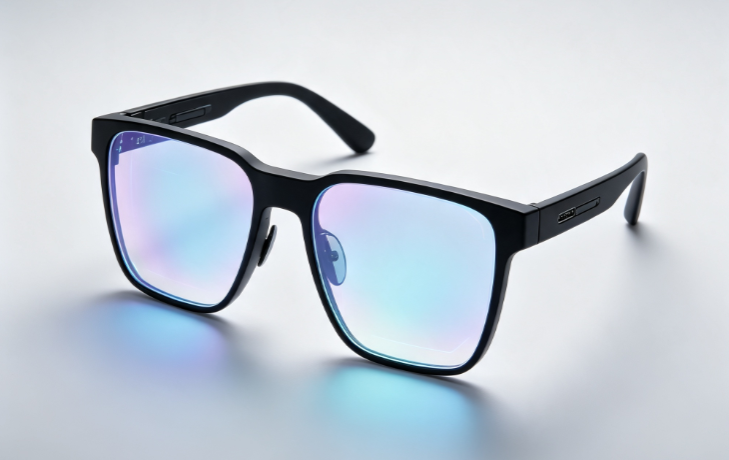
Without micro-display modules, wearing an AR/VR device would feel like strapping two heavy smartphones to your face, causing extreme neck strain and motion sickness. Micro-display modules are the fundamental technological prerequisite for making AR glasses as lightweight and sleek as traditional prescription eyewear.
Real-World Applications & Product Case Studies
Micro-display modules are already powering many cutting-edge consumer tech products:
- VR / MR Headsets (e.g., Apple Vision Pro): The Vision Pro features twin 1.42-inch 4K Micro-OLED modules custom-manufactured by Sony, coupled with Apple’s proprietary 3-element Pancake optical system. To achieve dual-eye 4K resolution, the module utilizes an astonishingly fine pixel pitch of just 7.5 µm [6].
- AR / AI Smart Glasses (e.g., XREAL, RayNeo, Rokid): Devices like the XREAL Air 2 Pro leverage Sony Micro-OLED panels paired with BirdBath optics. While BirdBath designs are thicker than waveguides, XREAL integrates an electrochromic dimming film to adjust lens opacity in milliseconds, enabling bright, high-contrast viewing even in bright outdoor sunlight [7].
- FPV Drone Goggles (e.g., DJI FPV Goggles): High-end First-Person View goggles use micro-display modules to deliver low-latency, high-frame-rate feeds directly from racing and cinema drones.
- Electronic Viewfinders (EVFs): Digital SLR and mirrorless cameras rely on compact micro-display modules inside the eyepiece to give photographers precise real-time exposure and focus previews.
Key Engineering Challenges: Yield Rates & Thermal Management
Currently, the primary bottlenecks in commercializing micro-display modules lie in manufacturing yield rates and thermal management [8]:
- Yield Loss: Manufacturing Micro-OLEDs requires fabricating CMOS driver backplanes on 300mm (12-inch) silicon wafers, followed by organic layer evaporation. A single microscopic dust particle can short out hundreds of sub-pixels, causing significant yield loss.
- Thermal Dissipation: Operating micro-displays at high luminance outputs generates localized heat. If the module packaging fails to dissipate heat effectively, the thermal buildup conducts directly to the user’s face, compromising long-term wearing comfort and safety [8].
References
- Omdia Research. Microdisplay Market Tracker & Analysis.
- Display Supply Chain Consultants (DSCC). Microdisplay Market Outlook for AR/VR Applications.
- Kress, B. C. (2020). Optical Architectures for Augmented Reality Displays. SPIE Press.
- Chen, H. W., Tan, G., & Wu, S. T. (2021). “Sub-micron Micro-OLED display technology for next-generation AR/VR near-eye displays.” Liquid Crystals Reviews, 9(2), 89-105.
- Zhan, T., Yin, K., Xiong, J., He, Z., & Wu, S. T. (2020). “Augmented reality and virtual reality displays: emerging technologies and future perspectives.” Light: Science & Applications (Nature), 9(1), 1-28.
- Apple Inc. (2024). Apple Vision Pro Technical Specifications & Hardware Overview.
- XREAL Technology (2023). XREAL Air 2 Pro Optical & Electrochromic Architecture.
- Ghosh, G., & Lin, C. (2023). “High-Luminance Tandem Micro-OLED Architecture for Spatial Computing.” SID International Symposium Digest of Technical Papers, 54(1), 412-416.
Technical & Legal Disclaimer
This document is provided for educational, informational, and technical reference purposes only. Product specifications, hardware architectures, and market projections are subject to change by respective manufacturers and market research bodies. Reference to specific commercial products or brands does not constitute an endorsement or warranty.