Shenzhen Pengsheng MicroVision Tech Co., Ltd.

Micro RGB has emerged as a fast-growing topic of interest across the display industry in recent years.
Over the past few years, OLED has come to dominate smartphones and high-end televisions thanks to its perfect black levels and striking color reproduction. Yet as a long-time industry professional, I must emphasize that OLED’s inherent technical drawbacks—such as inevitable color shift over extended use and permanent burn-in from prolonged static imagery—have yet to be fully resolved.
So is Micro RGB truly the ultimate display solution? Does its so-called “native three-color inorganic luminescence” actually outperform OLED? This in-depth technical comparison breaks down the divergent technical paths of Micro RGB and OLED across five professional dimensions: pixel physical architecture, color accuracy stability, degradation mechanisms, manufacturing yield, and 24/7 commercial reliability.
Micro RGB vs OLED
| Technical Dimension | Micro RGB (Native Three-Color Inorganic LED) | OLED (Organic Light-Emitting Diode) |
| Emissive Material | Gallium Nitride (GaN) / Gallium Phosphide (GaP) Inorganic Crystals | Carbon-based Organic Polymer / Small-Molecule Thin Films |
| Full-Field Brightness (100% APL) | 1000 – 3000nits [1] | |
| Color Drift Mechanism | Extremely Low [3] | High (Accelerated aging of blue organic material causes color tinting) [4] |
| Burn-In / Image Retention | Excellent (Inorganic material, 0 pixel memory risk) | Susceptible (Requires pixel shifting; Tandem architecture only delays it) |
| Pixel Edge Sharpness | Ultra-High (Micro-scale chips provide clean geometric boundaries) | Slight Halos (Due to organic evaporation masks and polarizer diffraction) |
| Large-Scale Customization | Modular Seamless Splicing (100″ – 500″+ Any Aspect Ratio) | Restricted by Glass Substrate (Mass-production cap at 97″, Non-spliceable) |
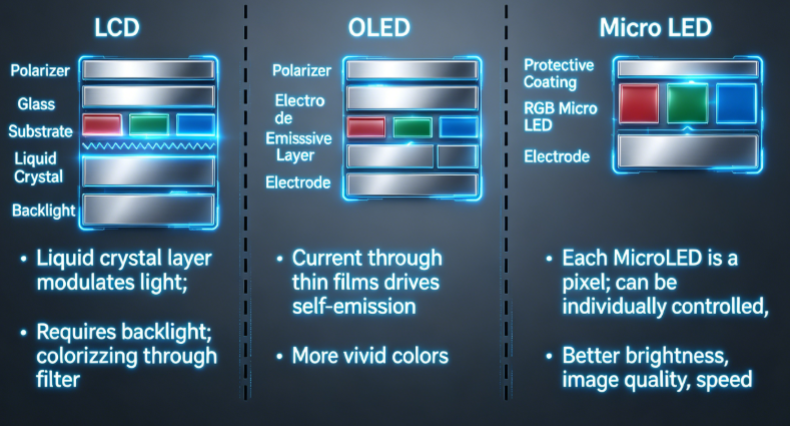
1. Core Definition: Micro RGB — The Definitive All-Inorganic Native Three-Color Display Technology
Most mainstream Micro LED products utilize a single blue-chip architecture paired with quantum dot color conversion, generating red and green pixels by exciting phosphorescent materials with blue light.
Micro RGB, by contrast, represents the industry’s premium native solution:
Each full pixel = Independent red GaN chip + Independent green GaN chip + Independent blue GaN chip
With fully independent primary color light sources, no color conversion layers, no color filters, and no optical loss through intermediate media, Micro RGB delivers the purest, most stable performance of any self-emissive display technology available today, coming closest to the theoretical optical ideal.
OLED operates on the exact opposite principle. Relying on carbon-based organic luminescent materials—whether in WOLED, QD-OLED, or tandem stacked OLED architectures—it is fundamentally based on organic thin-film emission, and thus inherently suffers from asymmetric material degradation.
2. Pixel Architecture Differences Between Micro RGB and OLED
2.1 Micro RGB: Balanced Three-Color Decay with Zero Long-Term Color Drift
All red, green, and blue chips in Micro RGB are fabricated from inorganic gallium nitride semiconductors, with highly consistent luminance decay curves across all three primary colors.
This delivers an engineering advantage that OLED can never match:
no color shift and no need for repeated calibration, even after tens of thousands of hours of continuous operation. For professional video monitoring, 24/7 broadcast studio playout, and other long-duration use cases, Micro RGB outperforms all OLED products in color performance, and forms the core technical barrier for high-end display Premium Solutions.
In broadcast studio project acceptance testing, chromaticity drift is a make-or-break metric. After 12 months of continuous operation, the white point of conventional OLED monitors shifts toward yellow-green. To maintain the D65 standard color temperature, technical operations teams must perform regular calibration using 3D LUTs (3D Look-Up Tables), which drives up labor and maintenance costs, and also causes luminance clipping that distorts shadow detail. In our follow-up of real-world Micro RGB projects, we have found that thanks to the exceptional stability of gallium nitride (GaN) and gallium phosphide (GaP) materials, its chromaticity drift is virtually negligible.
2. OLED: Inherent Structural Color Shift
The biggest flaw of OLED is the completely uneven aging rate of its three primary colors. The blue organic emissive layer has a far shorter lifespan than the red and green layers. After prolonged use, the screen develops overall yellowing, color temperature drift, and degraded shadow color accuracy. For this reason, OLED is not deployed in professional broadcasting facilities or command centers, where high-end Micro RGB solutions are the only viable option.
3. Luminance Mechanism Differences Between Micro RGB and OLED
To protect its delicate organic materials, OLED is mandatorily equipped with an ABL (Auto Brightness Limiter) mechanism: whenever the screen displays large areas of white or high-brightness content, luminance drops abruptly. For example, when a scene cuts suddenly from a dark setting to a snowy landscape, OLED will plummet from around 2,000 nits to roughly 250 nits to prevent thermal degradation caused by full-screen high current, leaving the image visibly dim and washed out. This is the fundamental reason OLED cannot be used for outdoor or exhibition hall applications.
Micro RGB’s inorganic chips, by contrast, withstand high temperatures and voltages with no risk of material degradation, eliminating the need for ABL restrictions entirely. It maintains a stable full-screen brightness of 1,000–3,000 nits consistently when displaying pure white frames, full-screen HDR highlights, or prolonged static imagery, making it particularly well-suited for high-ambient-light environments, unshaded daytime home theaters, and outdoor stage productions.
4. Substantial Gap in Commercial-Grade 24/7 Operation Capability
OLED: Unavoidable Static Image Retention Risk
Prolonged display of static elements such as TV station logos, live broadcast subtitles, user interfaces, and fixed menus inevitably causes uneven aging of organic pixels, resulting in permanent burn-in. Even the latest tandem dual-layer OLED can only slow this process, not eliminate it entirely.
Micro RGB’s inorganic semiconductor chips have no organic material degradation mechanism. Static imagery, fixed text, and long-term HUD displays leave no residual image retention whatsoever.
5. Pixel Image Quality: Micro RGB Outperforms OLED in Geometric Precision
- OLED: Organic emissive layers have soft, blurry edges with halo diffusion, and irregular pixel outlines.
- Micro RGB: Three independent micron-scale chips form a precise geometric matrix with clean pixel boundaries, uniform gaps, and no halo effect, delivering substantial advantages in image sharpness, solid-color purity, and edge resolution.
6. Size and Engineering Scalability
Constrained by glass substrate evaporation processes, the maximum mass-produced size of OLED panels is 97 inches, with no support for tiling, custom shapes, or ultra-large-format customization.
Micro RGB adopts COB (Chip on Board) packaging, enabling seamless implementation of 110-inch, 135-inch, and 163-inch home theater giant screens, as well as hundreds-of-inch commercial displays, curved screens, and custom-shaped screens. All high-end custom audio-visual projects and commercial space Premium Solutions rely on Micro RGB as their core display platform.
7. Final Selection Guide: Precise Use Case Differentiation Between Micro RGB and OLED
Choose OLED for:
Smartphones, tablets, mainstream esports monitors, and medium-to-small home televisions.
Choose Micro RGB: The exclusive Premium Solutions for high-end commercial and luxury residential audio-visual applications
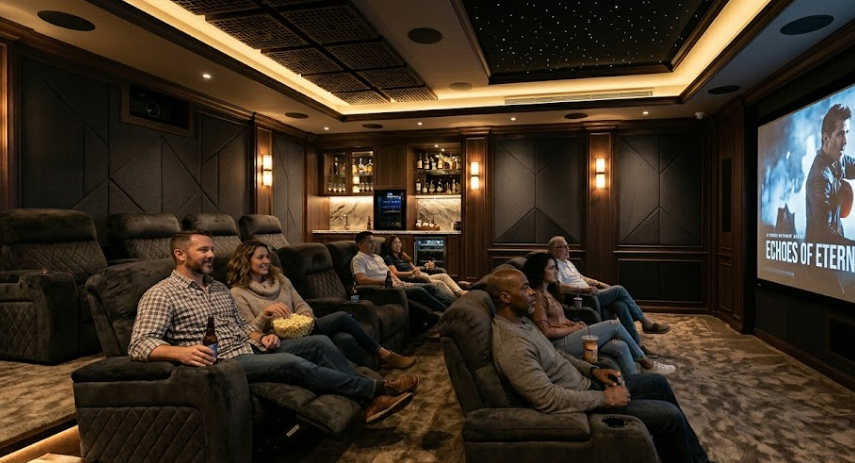
✅ Luxury villa private home theaters (high-ambient-light environments, all-day operation)
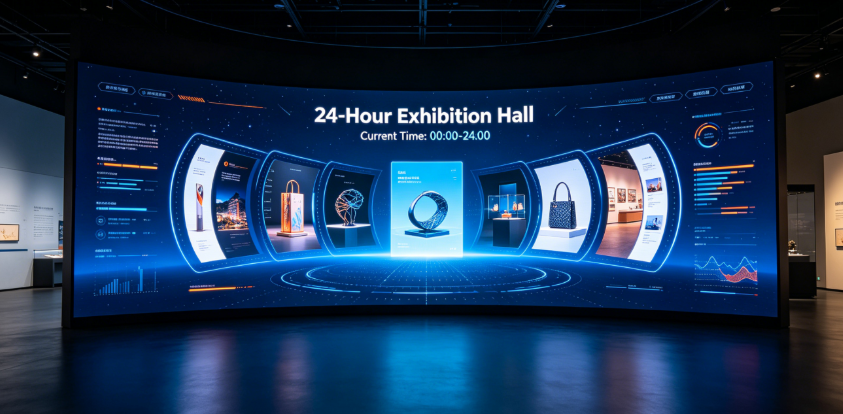
✅ Flagship brand stores, luxury retail window displays, 24-hour exhibition hall screens
✅ Professional color grading, broadcast studios, and MR virtual stage previsualization
✅ Outdoor high-brightness projects, custom-shaped giant screens, and ultra-large-format custom installations
✅ Professional scenarios with strict requirements for color accuracy stability, zero burn-in, and long-term performance consistency
8. Conclusion
Conventional Micro LED serves as an upgraded alternative to OLED, while Micro RGB represents the top-tier Premium Solutions in today’s display industry. OLED excels at consumer-grade dim-environment viewing, perfect black levels, and mature cost-effectiveness; Micro RGB stands out for its native three-color pure luminescence, zero color shift, complete burn-in immunity, all-weather high brightness, and customizable engineering capabilities.
All in all, in the fields of high-end commercial display and top-tier private audio-visual engineering, Micro RGB has established itself as the definitive next-generation ultimate display technology.
References
[2] IEEE Transactions on Electron Devices (2024): Analysis of Automatic Brightness Limiting (ABL) Mechanics in Large-Format Organic Light-Emitting Diodes.
[3] Journal of the Society for Information Display (JSID) (2024): Long-term Color Shift and Chromaticity Drift in Broadcast Monitor Technologies: Comparative Study of OLED vs. GaN-based Micro-LEDs.
[4] Nature Materials (2023): Degradation Mechanisms of Blue Organic Light-Emitting Diodes: A Review of Exciton-Polaron Quenching and Chemical Dissociation.
[5] CIE Publication No. 15-2023: Technical Report on Colorimetry and Long-Term Color Stability of Solid-State Lighting Elements.
[6] ITU-R Recommendation BT.2020-4 (2023): Parameter values for ultra-high definition television systems for production and international programme exchange.
[7] Display Technology Review (2025): Tandem OLED Architectures: Mitigation of Image Stick and Burn-in in Commercial Displays.
[8] Optics Express (2024): Pixel Edge Definition and Modulation Transfer Function (MTF) Comparison: Micro-RGB Semiconductors vs. Vacuum Evaporated OLEDs.
[9] Journal of Applied Physics (2024): The ‘Red Drop’ Effect in Micro-scale Light-Emitting Diodes: Efficiency Limitations of InGaN and AlGaInP Red Chips.
[10] Yole Développement Market & Technology Report (2025): MicroLED Displays 2025: Mass Transfer Yields, Cost Structures, and Manufacturing Challenges.
[11] Is Micro LED Better Than OLED? A Deep-Dive Comparison (Micro LED vs OLED)
About the Author
Leo Harrison has over a decade of experience in the East Asian display supply chain and display semiconductor industry, specializing in smart hardware architecture and display technology evaluation.
Review Team
Review Team:
Special technical review and engineering validation provided by the Pengsheng Technology R&D Division.