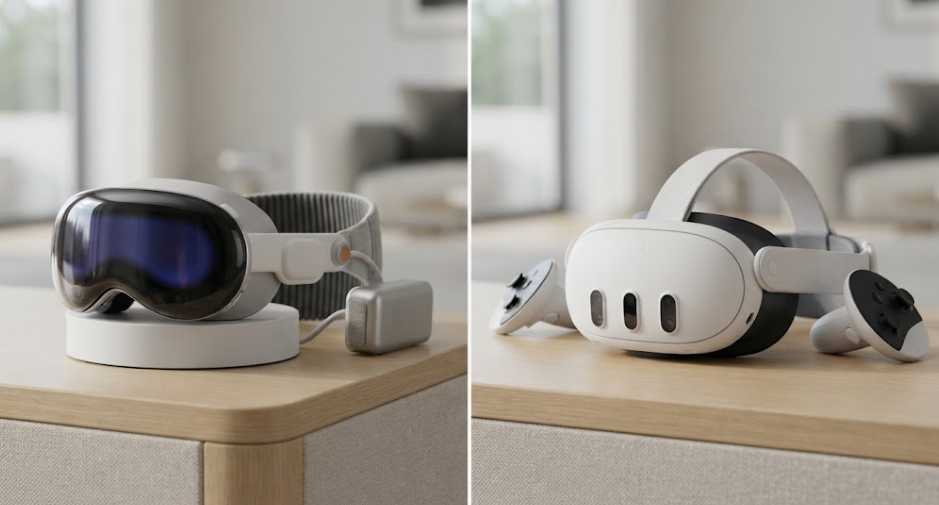

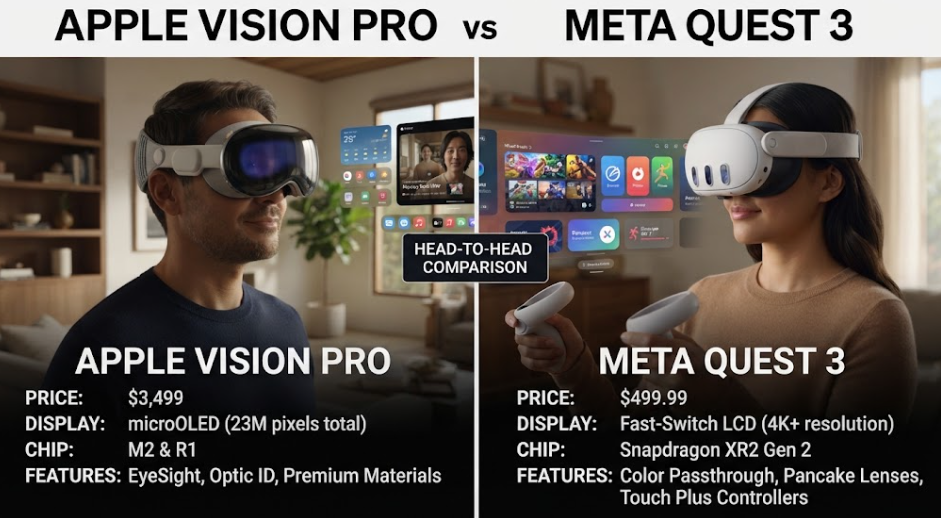
This comparison examines the Apple Vision Pro and Meta Quest 3 because the two devices represent today’s leading technical approaches for spatial-computing hardware: one optimised for uncompromising visual fidelity, the other built around cost-effective mass-market performance. Below is a structured table summarising key specifications.
Apple Vision Pro vs Meta Quest 3: Micro-Display and Pancake Optics Comparison
| Comparison Metric | Apple Vision Pro | Meta Quest 3 |
| Display Technology | Silicon-based OLED (Micro-OLED / OLEDoS) | Dual-panel QD-Fast LCD |
| Physical Panel Size (per eye) | 1.42 inches | 2.33 inches |
| Per-Eye Resolution | $3660 \times 3200$ (23 million total pixels) | $2064 \times 2208$ (9.1 million total pixels) |
| Pixel Density (PPI) | ~3,380 PPI | ~1,218 PPD |
| Angular Resolution (PPD) | ~34–40 PPD (near-retinal quality) | ~25 PPD |
| Native Contrast Ratio | >100,000:1 (true black with zero light leakage) | ~1,200:1 (grey-toned black floor) |
| On-Eye Brightness / Panel Peak Brightness | ~100–150 nits / >5,000 nits peak | ~100 nits / ~1,000 nits peak |
| Optical System | Custom 3-element folded Pancake lens assembly | 2-element Pancake lens assembly |
| Field of View (FOV) | Approx. 90°–100° (depends on facial interface seal) | 110° horizontal / 96° vertical |
| Refresh Rate | 90 Hz / 96 Hz / 100 Hz | 72 Hz / 90 Hz / 120 Hz |
1. Display Modules and Wafer Backplanes
- Vision Pro (Micro-OLED): Its backplane uses TSMC’s 28 nm silicon-based CMOS driver wafer. Sony manufactures the white-OLED emissive layer paired with RGB colour-filter stacks. The resulting pixel pitch delivers a physical pixel size of roughly 7.5 micrometres, virtually eliminating the screen-door effect and enabling highly immersive movie-viewing experiences.
- Quest 3 (Fast-LCD): Unlike Vision Pro’s Micro-OLED architecture, Quest 3 uses conventional glass-substrate panels (a-Si / LTPS) augmented by quantum-dot films for improved colour reproduction. While it upgrades over Quest 2 with dual displays and physical IPD adjustment, limited pixel aperture ratio yields a PPI roughly one-third that of Vision Pro. Individual pixels remain perceptible at close viewing distances, resulting in inferior subjective image sharpness.
2. Pancake Optics and Light-Utilisation Efficiency
Both headsets adopt polarised folded-light Pancake architectures to reduce axial optical-engine thickness, though polarising-stack absorption introduces substantial optical loss.
- Vision Pro Optics & Performance: Vision Pro offsets transmission losses by leveraging the Micro-OLED’s >5,000 nits peak luminance; sufficient raw output preserves good optical performance despite high light attenuation. In media playback, Vision Pro produces genuine pixel-level black states, with candle-like highlights and metallic reflections appearing vivid and lifelike, imparting a glass-like image quality.
- Quest 3 Optics & Performance: Quest 3 achieves brightness by driving high-power backlights, which demands elevated system power draw. This design yields lower overall battery runtime and generates significant thermal output. In cooler ambient conditions, temperature differences around the eyepieces can cause lens fogging. Without per-pixel dimming capability, Quest 3 cannot render true black levels.
Optical Distortion and Eye-Box Performance
- Vision Pro: Implements a rare 3-element Pancake lens set paired with real-time eye-tracking-driven field-of-view calibration. It delivers excellent suppression of edge distortion and coherent glare. That said, it is highly sensitive to facial-interface fit and headset alignment; misplacement causes noticeable softening toward image peripheries.
- Quest 3: Uses a simpler 2-element Pancake design with a larger Eye-Box and marginally wider FOV. Images stay sharp even with moderate headset shift, which occurs during high-motion gameplay or quick donning-and-doffing. This makes it well-suited for shared household use. Minor blooming artefacts appear around high-contrast edges; the effect is unobtrusive in bright game scenes but visible as faint halos around bright text or in dark environments.
3. Engineering Trade-offs and Bill-of-Materials Costs
- Vision Pro: Estimated BOM cost for one Micro-OLED display plus the 3-element optical assembly exceeds USD 450, accounting for nearly 30% of total hardware expenditure. High wafer defect rates and complex packaging-and-test workflows raise component costs, cementing its premium-grade positioning. Market data reflects its high price point. Unit shipments reached approximately 85,000 units across 2025, a steep 78% year-over-year decline from roughly 390,000 units in 2024. Q4 2025 alone totalled around 45,000 units. Its class-leading visual performance comes at a price that places it outside mainstream consumer reach.
- Quest 3: Total BOM for its display-and-optics package is held within the USD 80–100 range. Mature LCD manufacturing enables high-volume, cost-efficient mass production. Performance compromises include reduced dark-state contrast and lower maximum PPD, balanced against a 120 Hz refresh rate and strong value proposition for gaming-oriented consumers. The broader Quest family maintained annual shipments between 2 million and 2.5 million units in 2025. Its low-cost LCD-plus-Pancake implementation captures the bulk of consumer VR gaming and entertainment demand.
4. Video Passthrough and Latency
- Apple Vision Pro: Incorporates the dedicated R1 co-processor, which concurrently ingests data from 12 cameras, five sensors and six microphones. End-to-end passthrough latency falls below human visual-perception thresholds, with minimal spatial warping across peripheral vision.
- Meta Quest 3: Performs passthrough stitching via the main ISP integrated within the Snapdragon XR2 Gen 2 SoC, resulting in higher passthrough latency around ~39 ms. Visible image stretching can be observed for near-field objects undergoing rapid lateral movement.
5. Eye-Tracking and Foveated Rendering
- Apple Vision Pro: Embeds two infrared cameras plus annular LED illuminators behind each lens, capturing pupil gaze at high frame rates. Foveated rendering applies maximum-quality rendering only within a 1.5°–2° central field aligned with the user’s gaze, reducing computational load across peripheral regions.
- Meta Quest 3: Contains no hardware eye-tracking. It relies on static foveated rendering: peak resolution is fixed at the optical centre, with peripherals consistently down-sampled regardless of actual eye position. Users perceive pronounced softness when viewing content using peripheral vision.
6. IPD Adjustment and Prescription-Lens Compatibility
- Apple Vision Pro: Calculates interpupillary distance via eye-tracking cameras. Built-in micro-motors provide smooth, stepless electronic IPD adjustment across the 51–75 mm range. Custom-magnetic ZEISS prescription inserts are supported, with display-side distortion-compensation algorithms tuned for those lenses.
- Meta Quest 3: Features a bottom-mounted manual stepless dial for IPD tuning over 58–70 mm; users manually adjust for optimal subjective sharpness. Prescription correction requires third-party clip-on lens adapters.
References
[1] Yole Intelligence. (2026). Micro-Display and Pancake Optics Benchmark Report for Consumer XR Headsets.
[2] Display Supply Chain Consultants. (2026). BOM Breakdown: Apple Vision Pro and Meta Quest 3.
[3] IDC. (2026). Global AR-VR Headset Shipment Tracker 2024–2025.
[4] SID. (2025). OLEDoS versus QD-Fast-LCD: Optical-Performance Comparison for Spatial-Computing Devices.
[5] Meta Hardware Engineering. (2024). Quest 3 Pancake Optics and Display Technical Overview.
[6] Apple Platform-Technologies Documentation. (2024). Vision Pro R1 Processing and Passthrough Latency Specification.
Legal Disclaimer
This document serves purely for independent technical analysis and reference. It is not product-specification documentation, procurement guidance or commercial-investment advice. All trademarks belong to their respective owners. BOM figures and shipment volumes are industry estimates derived from third-party market research; real-world values may deviate. Subjective visual quality varies with facial fit, runtime settings and individual user vision. All parameters should be cross-checked against official vendor datasheets before commercial-project deployment. No express or implied warranty of accuracy or completeness applies.