A core challenge confronting microdisplay developers worldwide is balancing ultra-high resolution with low power consumption. This is not merely a matter of energy efficiency. Older technical approaches designed to achieve high pixel density often cause devices to overheat during extended use.
The Apple Vision Pro serves as a prominent example. To deliver exceptional visual clarity and eliminate the screen-door effect, it is equipped with ultra-high-resolution Micro-OLED panels. However, its power draw is substantial; the external battery only delivers roughly 2 hours of runtime under regular use. This illustrates that without deep innovations in underlying backplane driving and pixel architecture, high power consumption brought by ultra-high resolution will remain a major technical bottleneck limiting industry progress.
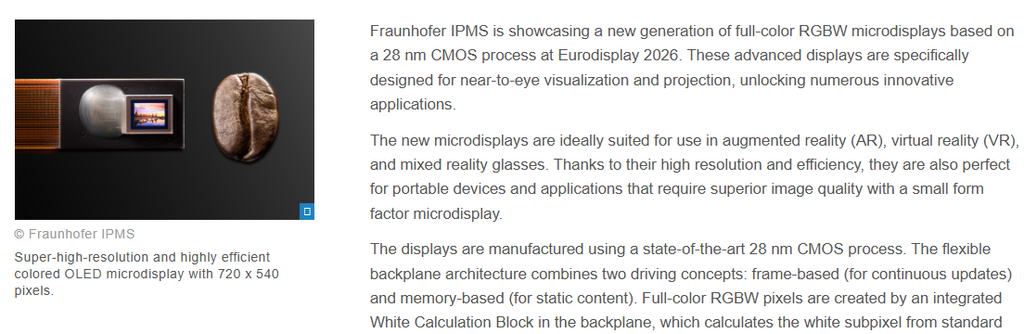
A leading European research institute for near-eye display technology has recently achieved another major milestone: Germany’s Fraunhofer IPMS has released a 5040 PPI full-color RGBW microdisplay.
1. Advanced 28 nm Process, Debuted at Eurodisplay 2026
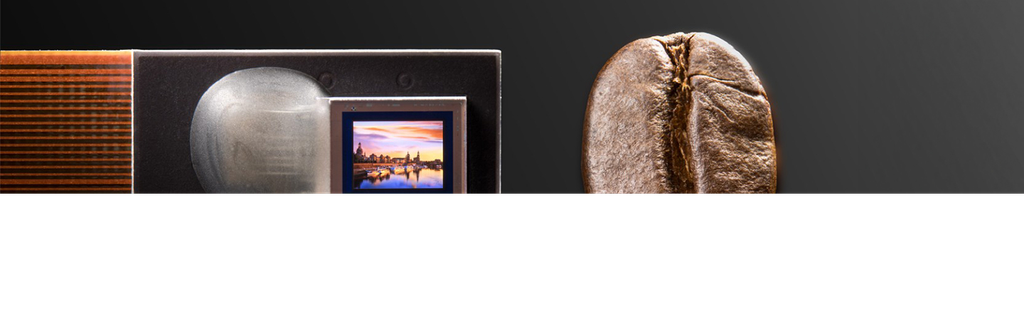
On September 21, Germany’s Fraunhofer Institute for Photonic Microsystems (Fraunhofer IPMS) officially announced its team had developed a full-color RGBW OLED microdisplay built on an advanced 28 nm CMOS process. This innovation made its public debut at Eurodisplay 2026 in Dublin, Ireland.
2. Micron-Scale Pixels and Exceptional 5040 PPI Performance
The microdisplay features a native resolution of 720×540, engineered for near-eye displays and projection systems, including lightweight wearable AR (augmented reality), VR (virtual reality) and MR (mixed reality) devices.
Its standout breakthrough lies in extreme pixel density. With tiny subpixels measuring just 2.52 × 2.52 micrometers, the panel reaches a peak pixel density of 5040 PPI while retaining excellent luminous efficiency.
What does 5040 PPI mean in practical terms? Flagship smartphones commonly sit around 400–500 PPI, at which point pixel grains become nearly invisible to the human eye. Most premium VR headsets available today typically range from 1500 to 3500 PPI.
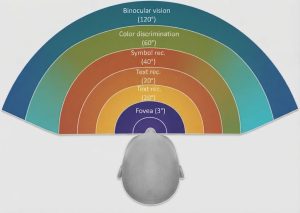
Packing full-color pixels at such extreme density within a 2.52 × 2.52 micrometer footprint completely eliminates the screen-door effect in AR/VR glasses. When immersed in virtual environments, rendered text, object edges and fine details deliver ultra-sharp visuals approaching real-world perception.
This technological leap outperforms many competing solutions. Mass-produced or pilot-stage Micro-OLED panels built for AR/VR generally land between 2500 and 4000 PPI. For instance, Fraunhofer IPMS’ earlier SXGA microdisplay reached approximately 2644 PPI. High-end microdisplay panels from Sony, Rayvision, Kopin and other vendors mostly fall within this same range.
Application Outlook & Market Advantages
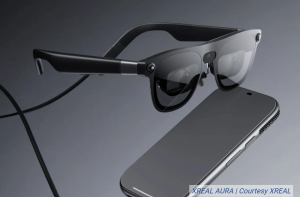
Current AR glasses force tradeoffs between compact size, limited battery life and crisp visuals. This low-power 5040 PPI Micro-OLED panel enables AR eyewear slim enough to resemble ordinary prescription glasses.
Additionally, the total elimination of the screen-door effect lets users view 3D films, play VR games or join remote work sessions with razor-sharp text edges and fully rendered fine details.
3. Innovative Dual-Drive Architecture and RGBW Four-Color Pixel Design
To unlock long battery life on lightweight wearables, the product introduces foundational technical innovations:
- Dual-mode backplane architecture: The backplane integrates two driving schemes. Frame drive mode is optimized for smooth video playback. Storage drive mode targets static content, refreshing only pixels that change, drastically cutting power usage.
- Intelligent white calculation unit: The microdisplay includes a proprietary white calculation unit that computes and generates white subpixel data in real time from standard RGB image inputs, forming an efficient four-color RGBW pixel structure. This lifts overall brightness while further reducing power draw.
Legacy AMOLED smartwatches, such as early Wear OS devices with Always-On Display (AOD), lacked comparable technology. To keep watch faces and time visible, they had to maintain high brightness, draining battery rapidly.
The same issue affects automotive HUDs (head-up displays). In bright sunlight, conventional RGB panels crank backlight brightness to maximum so drivers can read navigation and speed data, resulting in heavy power draw and excessive heat buildup.
4. Lightweight Form Factor & Extended Runtime
Philipp Wartenberg, Head of IC and System Design at Fraunhofer IPMS, commented on the solution: compared with conventional microdisplays, this new design achieves the dual benefits of lower power consumption and higher resolution. Its flexible driving scheme seamlessly balances fluid high-speed video playback and ultra-low-power rendering for static imagery.
As Europe’s leading R&D hub for near-eye display technologies, Fraunhofer IPMS offers comprehensive end-to-end development services.
5. Collaborative Innovation: Pushing the Boundaries of Micro LED
Beyond OLED research, Fraunhofer IPMS has recently made notable advances in Micro LED technology. The institute has entered a deep partnership with Germany’s QubeDot to co-develop a blue Micro LED microdisplay with WUXGA resolution. The panel delivers 1920×1200 resolution and a 120 Hz refresh rate, alongside industry-leading performance metrics: single-pixel power consumption of only 2 microwatts and peak brightness reaching the order of 10 million nits.
References
[1] Society for Information Display (SID). Low-Power Design Challenges for Near-Eye Microdisplays.
[2] Apple Inc. Apple Vision Pro Technical Overview.
[3] Fraunhofer IPMS. New 5040 PPI RGBW OLED Microdisplay for AR/VR/MR Presented at Eurodisplay 2026.
[4] SID Display Week. Screen-Door Effect and Pixel Density Requirements for AR/VR Near-Eye Displays.
[5] Kopin Corporation. Microdisplay Product Portfolio for AR & VR Headsets.
[6] OLED Association. RGBW Pixel Architecture for Power and Brightness Optimization.
[7] SAE International. Automotive HUD Display Performance and Power Tradeoffs in High Ambient Light.
[8] Fraunhofer IPMS. Fraunhofer IPMS and QubeDot Collaborate on Ultra-High Brightness WUXGA Micro LED Microdisplay.
Disclaimer
Disclaimer: This article covers technical research results from Fraunhofer IPMS for informational purposes only. The described microdisplay remains a research prototype and is not yet commercially available. Display performance, power consumption and manufacturing yield may change during further development. The author and publisher bear no responsibility for decisions based solely on this article. All referenced external links belong to their respective owners and do not constitute endorsement.