Shenzhen Pengsheng MicroVision Tech Co., Ltd.



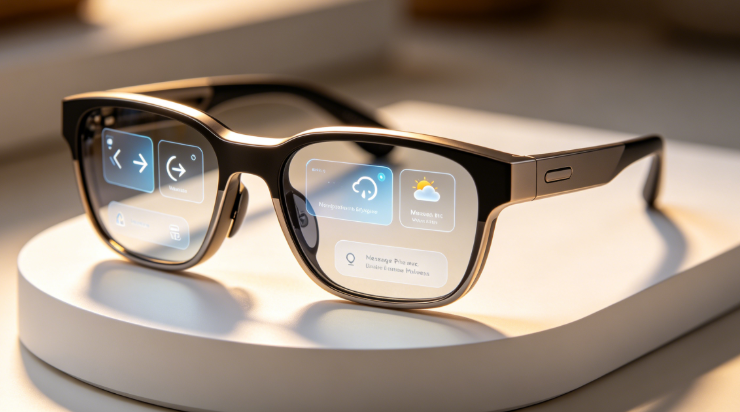
AR glasses are poised to become the primary terminal device of the spatial computing era. Driven by advances in on-device multimodal AI—including Apple Intelligence and Google Gemini XR—and breakthroughs in micro-optics manufacturing, consumer AR glasses shipments are set for explosive growth in 2026.
As one report puts it: “2024 marked the trial phase for AI-powered audio smart glasses; 2026 will see the popularization of budget spatial display glasses priced under 2,000 RMB; and 2027 will be the first year of genuine AR ecosystem adoption—combining waveguides, full-color micro-displays, and proactive AI. AR is repeating the dramatic technological leap from the iPhone 3GS to the iPhone 4.” — Counterpoint 2027 Global Frontier Electronics Tracking Report
I. Optical Architecture Evolution: Waveguide Technology
The central challenge in AR optics lies in navigating the “impossible trilemma”: achieving an ultra-slim form factor, a sufficiently wide field of view (FOV) with adequate eyebox, and high optical efficiency bright enough to withstand intense outdoor sunlight.
1.1 Limitations of Early Technology Approaches
Prism, free-form, and Birdbath solutions each dominated specific periods in AR’s evolution, yet all carry fundamental tradeoffs:
Prism architecture (exemplified by Google Glass 2): An irreconcilable tradeoff exists between physical bulk and FOV. Thick and bulky, these devices achieve only 40–50% light transmittance. With a minuscule FOV of 10°–20°, they fail to deliver genuine immersion and have been largely phased out of the market.
Free-form architecture (exemplified by Epson Moverio BT-45C): While complex asymmetric curved surfaces correct aberrations and expand FOV to 34° while offering industrial-grade durability, the optical module is so heavy that all-day consumer wear is practically infeasible.
Birdbath architecture (exemplified by XREAL Air 2 Ultra and Rokid Max): With a wide 50°–52° FOV, strong color performance, and low manufacturing costs, Birdbath devices successfully created a market for portable large-screen media consumption between 2024 and 2026. However, their light transmittance is extremely low—optical efficiency hovers around just 15%. This causes severe thermal discomfort and inadequate battery life in outdoor scenarios.
As industry analyst Karl Guttag observed: “Birdbath validated consumer enthusiasm for AR glasses, but it remains an imperfect solution for the AR era. You can’t realistically work indoors wearing sunglasses with only 25% transmittance.”
II. Waveguide Technology
To break the physical constraints of geometric optics, the industry has converged on waveguide technology as the definitive path forward. The core principle is folding the optical path and confining light within a transparent lens under 3mm thick via total internal reflection (TIR).
2.1 Geometric Array Waveguides
Geometric array waveguides rely on traditional precision optical fabrication. Multiple semi-reflective surfaces are laminated or bonded together through high-precision coating with controlled reflection/transmission ratios, then cut at precise angles.
Two-dimensional pupil expansion: Single-dimensional pupil expansion still yields bulky overall devices. Two-dimensional expansion structures, by contrast, spread the exit pupil both horizontally and vertically, dramatically shrinking the projector engine while easily widening the FOV.
Manufacturing evolution:
Early polymer lamination processes suffered from curing shrinkage that introduced stray light, relied on scarce high-index optical adhesives, and degraded or cracked with prolonged use.
By 2026–2027, automated molecular bonding has become the industry standard. Using intermolecular forces for direct adhesion, this technique achieves nanometer-level surface flatness, eliminating background black stripes and color distortion while lifting overall production yield for two-dimensional expanded-pupil products above 60%.
2.2 Diffractive Waveguides
Diffractive waveguide technologies—including surface relief gratings (SRG) and polarization volume gratings (PVG)—have become the standard configuration for consumer-grade AR.
Historically, conventional high-index heavy flint glass capped the FOV at 30°–40°. Meta’s flagship AR hardware, by contrast, employs silicon carbide (SiC) or high-index crystal substrates, pushing the refractive index above 2.6. Raising the substrate’s refractive index from 2.0 to 2.6 enables a single-layer lens to achieve a 70° FOV.
PVG cost reduction:
Traditional SRG manufacturing depends heavily on semiconductor lithography and nanoimprint equipment. The emerging PVG approach leverages the polarization selectivity of liquid crystal materials and can be fabricated in a single holographic exposure step.
PVG nearly doubles optical efficiency compared to conventional SRG. Supply chain data indicates that by 2027, per-unit PVG production costs will be 45% lower than SRG—making it ideally suited for high-performance AI-AR glasses in the 1,999–2,999 RMB price bracket.
III. Micro-Display Advances: Full-Color Micro-LED Breakthrough and Multimodal AI Integration
Waveguide optics impose extremely demanding requirements on the peak brightness of micro-display chips.
3.1 Comparative Analysis of Three Micro-Display Technologies
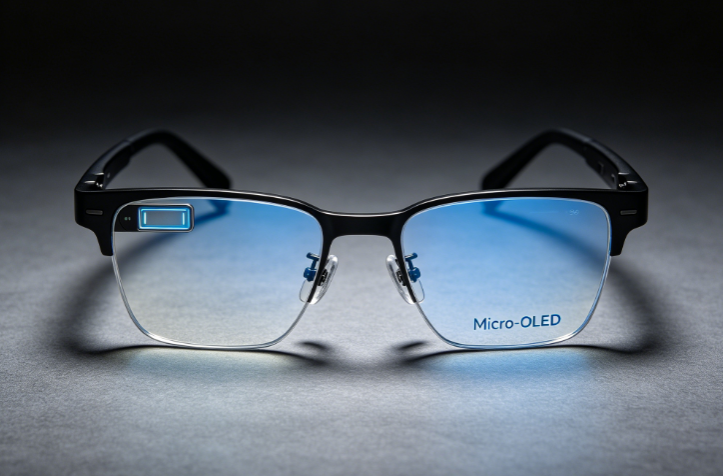
| Metric | LCoS (Liquid Crystal on Silicon) | Micro-OLED (OLED on Silicon) | Micro-LED (Ultimate Solution) |
|---|---|---|---|
| Theoretical Peak Brightness | ~50,000 nits | ~10,000 nits (degrades in strong outdoor light) | >1,000,000 nits (unaffected by direct sunlight) |
| Power Consumption | Baseline (100%) | ~50% | ~10% (extremely efficient) |
| Pixel Density (PPI) | ~3,000 | ~4,000 | >10,000 |
| 2027 Market Positioning | Used by Meta and others for transitional cost reduction | Dominant for media/VR; being phased out of true AR | Definitive standard for flagship true AR glasses |
3.2 Key 2027 Breakthrough: Mass Production of Monolithic Full-Color Micro-LED
Historically, Micro-LED development was constrained by two bottlenecks: the difficulty of mass transfer for red pixels, and the sharp drop in red LED efficiency at micro-scales.
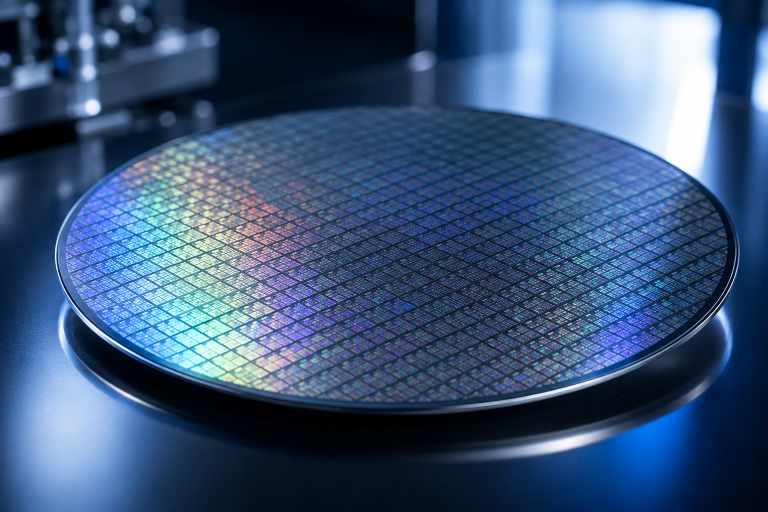
The industry has now converged on quantum dot (QD) color conversion as the solution. By combining high-efficiency blue/green Micro-LED chips with an inkjet-printed quantum dot color conversion film (QDCF), monolithic full-color displays are achieved directly on a single wafer.
In 2027, Samsung Electronics is partnering closely with South Korea’s Sapien Semiconductors—supplying ultra-compact Micro-LED driver backplane ASICs manufactured by GlobalFoundries—to scale production of full-color Micro-LED modules exceeding 10,000 PPI.
IV. Consumer AR in 2027: Toward All-Day Everyday Wear
4.1 Weight Reduction
Qualcomm’s Snapdragon AR1 platform and its successors have substantially reduced everyday power consumption. Eliminating the need for active fan cooling, on-device processing handles lightweight voice and visual AI workloads directly on the glasses.
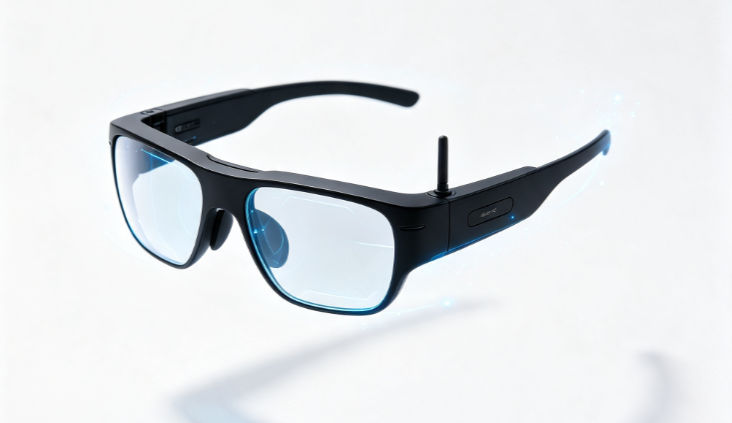
Furthermore, 2027’s mainstream all-in-one devices are ditching bulky plastic enclosures in favor of integrated titanium alloy internal frames paired with ultra-light polymer resin waveguide lenses. Apple’s fashion-focused smart glasses line, codenamed Project N50, has brought total device weight down to 42–48 grams—visually indistinguishable from a classic pair of Ray-Ban Wayfarers.
4.2 Multimodal AI and First-Person Spatial Awareness
In 2027, the combination of “AI + spatial perception” elevates AR glasses into a standalone first-person computing platform.
First-person camera/sensor capture → On-device lightweight LLM multimodal recognition → Real-world information overlay via waveguide
Benchmark case: Google × Android XR native ecosystem
In the latest Android XR glasses launching summer 2027, the Gemini multimodal large language model is integrated natively at the system level. An ultra-low-power camera enables “proactive intelligent awareness”:
- Real-world turn-by-turn navigation: Walking through New York City, Google Maps directional arrows are rendered as 3D overlays directly on the pavement via silicon carbide waveguides.
- Multilingual simultaneous interpretation: During conversations with international business contacts, translated subtitles appear in real time rendered beside the speaker.
- Proactive product lookup: Recognizing a product in front of the wearer triggers automatic cross-platform supply chain price comparison.
V. Summary and 2027 Outlook
IDC’s 2027 industry analysts observe that while 2024’s “display-less AI audio glasses”—led by Meta Ray-Ban—introduced consumers to AR eyewear, 2027 will mark the beginning of the next consumer adoption cycle for genuine spatial computing AR, built on monolithic full-color Micro-LED, high-index waveguide lenses, and native Apple/Google operating system integration.
References
[1] Counterpoint Research, via PR Newswire. “RayNeo Leads Global AR Smart Glasses Shipments in Q1 2026.” PR Newswire, July 6, 2026.
[2] Guttag, Karl. “Karl Guttag’s Technical Deep-Dive and Analysis of Consumer XR Displays and LCoS.” Voices of VR Podcast #1621, August 2, 2025.
[3] Society for Information Display. “Analyzing Optics’ Pivotal Role in Augmented and Mixed Reality Displays.” SID Information Display, March 20, 2023.
[4] Southeast University. “World’s First PVG Waveguide AR Glasses Released.” Official Press Release, October 24, 2024.
[5] Lee, K., et al. “Switchable Polarization Volume Gratings for Augmented Reality Waveguide Displays.” CREOL, University of Central Florida, March 18, 2023. https://api.creol.ucf.edu/Publications/16768.pdf
[6] Society for Information Display. “Full-Color Micro-LED Near-Eye Display Technology Based on Quantum Dot.” SID Digest, 2025.
[7] Advanced Materials. “Monolithic Integration of Full-Color Microdisplay Screen with Sub-5 µm Quantum-Dot Pixels.” Wiley Online Library, September 12, 2024.
[8] DIGITIMES. “Sapien breaks into Meta’s AR supply chain, challenging China’s grip on smart glasses components.” DIGITIMES, December 17, 2025.
[9] IDC. “Smart Glasses Surge: The XR Market Is Rewriting Its Own Rules.” IDC Resource Center, June 15, 2026.
About the Author
Leo Harrison has over a decade of experience in the East Asian display supply chain and display semiconductor industry, specializing in smart hardware architecture and display technology evaluation.
Review Team
Review Team:
Special technical review and engineering validation provided by the Pengsheng Technology R&D Division.