Shenzhen Pengsheng MicroVision Tech Co., Ltd.


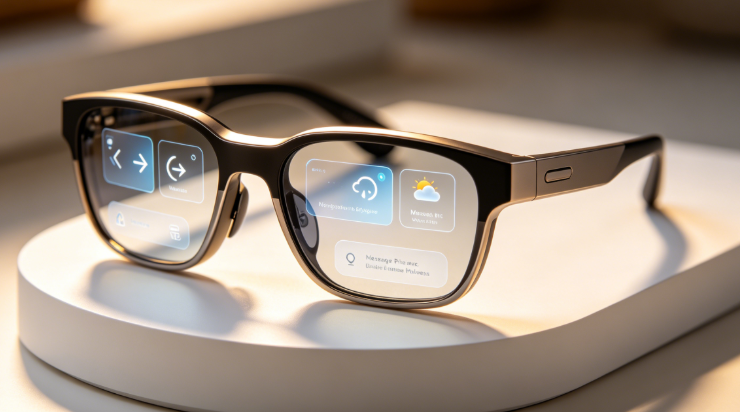

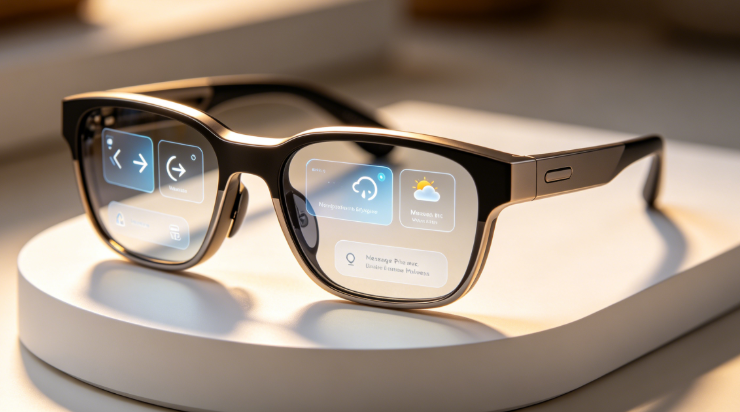
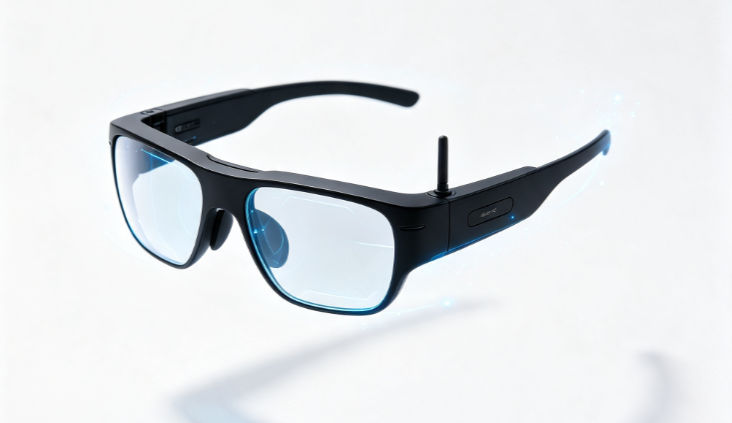
Combining waveguide technology with Micro OLED microdisplays has become one of the dominant approaches to developing lightweight AR navigation eyewear with high light transmittance.
However, this pairing comes with a fundamental physical limitation: extremely low optical efficiency. Over 90% of light is lost during refraction and total internal reflection inside the waveguide. For this reason, multiple critical factors must be weighed when picking the optimal Micro OLED panel for waveguide-based navigation glasses.
1. Optical Architecture of Waveguide AR Systems
Before selecting a display, it is critical to understand how virtual imagery travels through the waveguide to the human eye.
As illustrated in the diagram, virtual light emitted by the Micro OLED is first coupled into the waveguide substrate via projection optics. The light then undergoes repeated total internal reflection before being decoupled and directed toward the viewer’s eye.
This optical path inherently introduces five unavoidable drawbacks: optical power loss, optical distortion, pixel offset magnification, luminance attenuation, and uneven brightness distribution. As a result, microdisplays must meet exceptionally strict performance standards. Waveguides impose far tighter constraints on Micro OLED specifications compared to Pancake or conventional Birdbath optical architectures.
2. Key Criteria for Micro OLED Optimized for Waveguide AR Navigation Glasses
2.1 Brightness & Luminous Efficiency
Waveguides typically deliver an overall optical efficiency of merely 1% to 5%. To render navigation prompts legible under direct sunlight, the light reaching the eye needs a minimum luminance of 1,000 nits. This translates to a required native panel brightness of 10,000 to 30,000 nits for the Micro OLED itself.
Recommended Solution: Prioritize high-luminance Micro OLED panels built on tandem stacked OLED structures, or mass-produced variants integrated with wafer-level Micro Lens Arrays (MLA) to boost light extraction efficiency.
2.2 Ultra-Low Power Consumption
Navigation glasses are designed for extended wear sessions, such as 2–3 hours of continuous cycling. To maintain a slim, lightweight form factor, only compact low-capacity batteries can be fitted within the temple arms.
CMOS display driver ICs (DDIC) fabricated on advanced high-voltage process nodes — including 55nm embedded high-voltage (eHV) or 22nm fully depleted FDX SOI — deliver minimal static power draw and superior leakage current suppression.
For basic navigation output consisting solely of route arrows and text, monochrome mono-green Micro OLED offers the highest power efficiency. For complex real-world AR overlay graphics, low-power high-brightness full-color modules are required instead.
2.3 Miniaturized Form Factor & Ultra-High PPI
For mass consumer adoption, AR navigation glasses must match the slim profile of standard prescription eyewear.
Consumer-grade navigation headsets therefore rely on compact Micro OLED panels ranging from 0.13” to 0.39” in diagonal size. To eliminate the visible screen-door effect at near-eye viewing distances, panels must achieve a pixel density of no less than 3,000 PPI.
3. Matching Micro OLED to Waveguide Variants
Waveguides fall into two primary categories: geometric array waveguides and diffractive waveguides. Each requires a distinct Micro OLED pairing strategy based on optical performance:
| Waveguide Type | Optical Efficiency | Chromatic Aberration & Color Shift | Optimal Micro OLED Matching Strategy |
|---|---|---|---|
| Geometric Array Waveguide | Relatively high (~3%–5%) | Mild, accurate color reproduction | Compatible with both full-color and mono high-brightness Micro OLED; ideal for full-color AR navigation mapping |
| Diffractive Waveguide (SRG / VHG) | Extremely low (~1%–2%) | Severe, prone to rainbow artifacts | Mono-green high-luminance Micro OLED is strongly recommended. Green emitters centered at 530 nm deliver exceptional luminous output, offsetting the waveguide’s poor light throughput and suiting text-and-arrow-only navigation use cases |
4. Supply Chain & Solution Partner Selection
When sourcing micro-display products and custom backplane designs, emerging micro-display integrators such as Pengsheng MicroVision deliver tailored engineering value.
The firm develops proprietary ultra-low-power high-voltage backplane architectures with extensive targeted tuning to cut transistor leakage current and refine pixel anode planarization smoothness.
Final Selection Guidelines
- Text & arrow-only navigation: Pair a ~0.23” mono-green high-brightness Micro OLED with a diffractive waveguide.
- Full-color map & complex AR overlay navigation: Select a tandem stacked full-color Micro OLED under 0.39” combined with a geometric array waveguide, paired with a custom low-power display backplane.
References:
[1] Fu S, Chang Y. Light extraction in tandem organic light emitting diodes[R]. University of Texas at Austin, 2021.
[2] Wang L et al. Flexible Tandem White Organic Light-Emitting Devices with Over 46% External Quantum Efficiency via Micro-Lens Outcoupling[J]. Advanced Materials Technologies, 2024.
[3] Society for Information Display. High-Voltage CMOS Backplanes for High-Brightness OLED Microdisplays[R]. SID Digest, 2026.
[4] 360iResearch. Micro OLED Optical Engine Global Market Forecast 2026–2032[R]. Jan 2026.
[5] Tencent Cloud Developer Community. Brightness Bottleneck Breakthrough of Micro Displays for Outdoor AR Glasses[Report]. May 2026.
[6] Shen Z et al. Design and Realization of Full-Color VHG Holographic Waveguide Display[C]//SID Symposium Digest, 2022.
[7] arXiv. Surface Relief Grating Near-Eye Display Waveguide Design[R]. 2023.
[8] IEEE Xplore. Polarized Volume Holographic Grating Waveguide AR Display with Improved Light Efficiency[C]. 2021.
[9] SID. New Isolated Pixel Structure for >4900 PPI High-Luminosity Micro OLED Panels[J]. Journal of SID, 2026.
About the Author
Leo Harrison has over a decade of experience in the East Asian display supply chain and display semiconductor industry, specializing in smart hardware architecture and display technology evaluation.
Review Team
Review Team:
Special technical review and engineering validation provided by the Pengsheng Technology R&D Division.